PRE 14A: Preliminary proxy statement not related to a contested matter or merger/acquisition
Published on
UNITED STATES
SECURITIES AND EXCHANGE COMMISSION
Washington, D.C. 20549
(RULE 14a-101)
SCHEDULE 14A INFORMATION
PROXY STATEMENT PURSUANT TO SECTION
14(a) OF THE SECURITIES
EXCHANGE ACT OF 1934
(AMENDMENT NO. __)
Filed by the Registrant ☒
Filed by a Party other than the Registrant ☐
Check the appropriate box:
| ☒ | Preliminary Proxy Statement |
| ☐ | Confidential, For Use of the Commission Only (as Permitted by Rule 14a-6(e)(2)) |
| ☐ | Definitive Proxy Statement |
| ☐ | Definitive Additional Materials |
| ☐ | Soliciting Material under §240.14a-12 |
(Name of Registrant as Specified In Its Charter)
(Name of Person(s) Filing Proxy Statement, if other than the Registrant)
Payment of Filing Fee (Check the appropriate box):
| ☒ | No fee required |
| ☐ | Fee paid previously with preliminary materials. |
| ☐ | Fee computed on table in exhibit required by Item 25(b) per Exchange Act Rules 14a6(i)(1) and 0-11. |

One Commerce Square
2005 Market Street, Suite 2400
Philadelphia, Pennsylvania 19103
(408) 627-4716
Important Notice Regarding the Availability
of Proxy Materials
for the Annual Meeting of Stockholders to Be Held on December 16, 2026
The Notice of Annual Meeting, Proxy Statement and
Annual Report on Form 10-K
are available at:
https://ir.datavaultsite.com/sec-filings/
NOTICE OF ANNUAL MEETING OF STOCKHOLDERS
TO BE HELD ON DECEMBER 16, 2026
To the Stockholders of Datavault AI Inc.:
NOTICE IS HEREBY GIVEN that the 2026 Annual Meeting of Stockholders (the “Annual Meeting”) of Datavault AI Inc., a Delaware corporation (the “Company,” “we,” “us” or “our”), will be held on December 16, 2026 at 1:00 p.m., Eastern Time, at the Company’s principal executive offices located at One Commerce Square, 2005 Market Street, Suite 2400, Philadelphia, Pennsylvania 19103, for the following purposes:
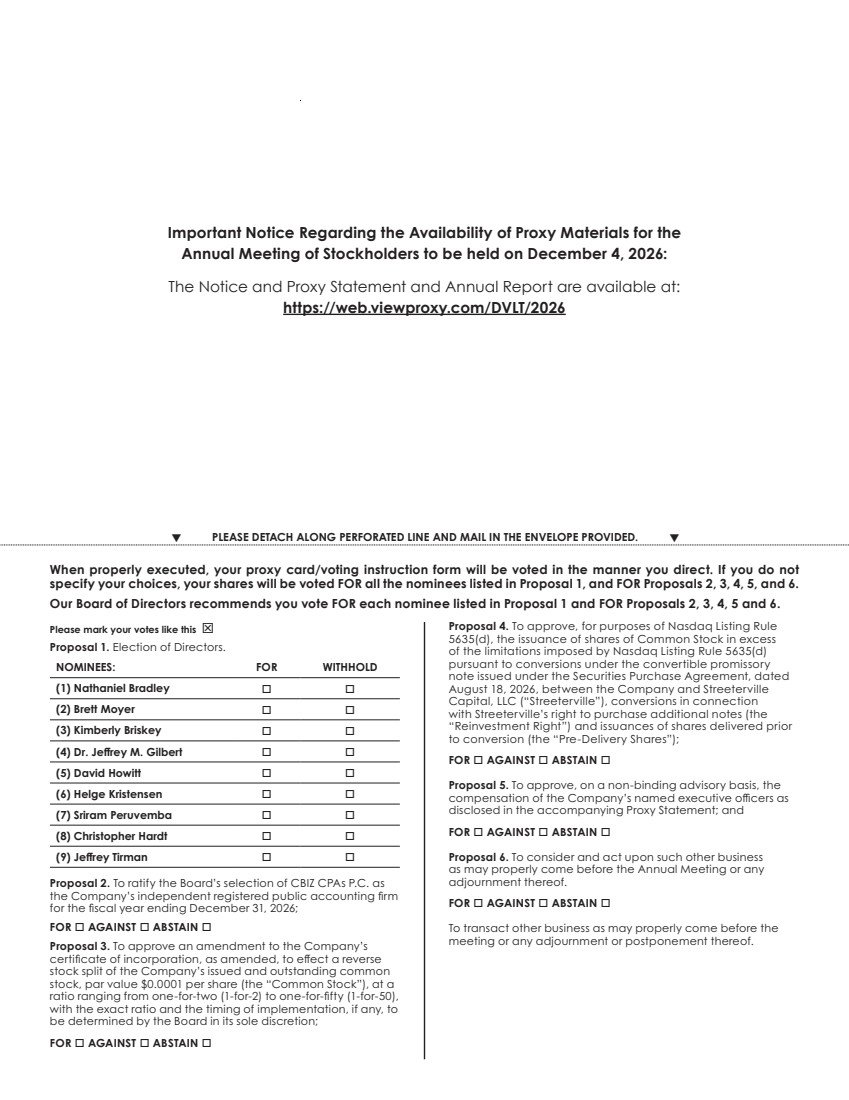
| 1. | To elect nine (9) members of the Company’s board of directors (the “Board”), each to serve until the next annual meeting of the Company’s stockholders and until each of their respective successors are elected and qualified or until each of their earlier resignation or removal; |
| 2. | To consider and vote on a proposal to ratify the Board’s selection of CBIZ CPAs P.C. as the Company’s independent registered public accounting firm for the fiscal year ending December 31, 2026; |
| 3. | To approve an amendment to the Company’s certificate of incorporation, as amended, to effect a reverse stock split of the Company’s issued and outstanding common stock, par value $0.0001 per share (the “Common Stock”), at a ratio ranging from one-for-two (1-for-2) to one-for-fifty (1-for-50), with the exact ratio and the timing of implementation, if any, to be determined by the Board in its sole discretion; |
| 4. | To approve, for purposes of Nasdaq Listing Rule 5635(d), the issuance of shares of Common Stock in excess of the limitations imposed by Nasdaq Listing Rule 5635(d) pursuant to conversions under the convertible promissory note issued under the Securities Purchase Agreement, dated August 18, 2026, between the Company and Streeterville Capital, LLC (“Streeterville”), conversions in connection with Streeterville’s right to purchase additional notes (the “Reinvestment Right”) and issuances of shares delivered prior to conversion (the “Pre-Delivery Shares”); |
| 5. | To approve, on a non-binding advisory basis, the compensation of the Company’s named executive officers as disclosed in the accompanying Proxy Statement; and |
| 6. | To consider and act upon such other business as may properly come before the Annual Meeting or any adjournment thereof. |
Each of the foregoing proposals is described in greater detail in the accompanying proxy statement, which forms a part of this Notice of Annual Meeting (the “Proxy Statement”). The Board has fixed the close of business on _______, 2026 as the record date for determining the stockholders entitled to notice of and to vote at the Annual Meeting or any adjournment or postponement thereof (the “Record Date”). Only holders of record of Common Stock as of the Record Date are entitled to notice of and to vote at the Annual Meeting or any adjournment or postponement thereof.
All stockholders who are record or beneficial owners of Common Stock as of the Record Date are cordially invited to attend the Annual Meeting in person. To be admitted to the Annual Meeting, stockholders of record must present valid photo identification, such as a driver’s license. Beneficial owners must also present evidence of beneficial ownership of Common Stock as of the Record Date, such as a brokerage account statement, bank statement or other similar evidence.
Whether or not you expect to attend the Annual Meeting, it is important that your shares of Common Stock be represented and voted during the Annual Meeting. We urge you to promptly complete, sign, date and return the enclosed proxy card in the enclosed postage-paid envelope in order to ensure representation of your shares of Common Stock. It will help in our preparations for the Annual Meeting if you would check the box on the form of proxy if you plan on attending the Annual Meeting. You may also vote by proxy (i) via the Internet or (ii) by telephone using the instructions provided in the enclosed proxy card. Your proxy is revocable in accordance with the procedures set forth in the Proxy Statement. Please be advised that if you are not a record or beneficial owner of shares of Common Stock on the Record Date, you are not entitled to vote and any proxies received from persons who are not record or beneficial owners of shares of Common Stock on the Record Date will be disregarded.
| Philadelphia, Pennsylvania | By Order of the Board of Directors, |
| November 18, 2026 | |
| Nathaniel Bradley | |
| Director and Chief Executive Officer |
WHETHER OR NOT YOU PLAN TO ATTEND THE ANNUAL MEETING, PLEASE PROMPTLY VOTE VIA INTERNET OR BY TELEPHONE, OR BY COMPLETING, SIGNING, DATING AND RETURNING THE ENCLOSED PROXY CARD IN THE ACCOMPANYING ENVELOPE. NO POSTAGE NEED BE AFFIXED IF THE PROXY CARD IS MAILED IN THE UNITED STATES.
TABLE OF CONTENTS
Page
i
ii
| FUTURE STOCKHOLDER PROPOSALS | 50 |
| EXPENSES AND SOLICITATION | 50 |
| OTHER BUSINESS | 50 |
| ADDITIONAL INFORMATION | 51 |
iii
PROXY STATEMENT FOR ANNUAL MEETING OF STOCKHOLDERS
In this proxy statement (“Proxy Statement”), Datavault AI Inc., a Delaware corporation, is referred to as “Datavault AI,” the “Company,” “we,” “us” and “our.”
Information Concerning the Proxy Materials and the Annual Meeting
Proxies are being solicited by our board of directors (the “Board”) for use at our 2026 Annual Meeting of Stockholders (the “Annual Meeting”) to be held at 1:00 p.m., Eastern Time, on December 16, 2026at the Company’s principal executive offices located at One Commerce Square, 2005 Market Street, Suite 2400, Philadelphia, Pennsylvania 19103, and at any adjournment or postponement thereof. Your vote is very important. This Proxy Statement contains important information for you to consider when deciding how to vote on the matters to be presented at the Annual Meeting. Please read it carefully.
Voting materials, which include this Proxy Statement, our Annual Report on Form 10-K for the fiscal year ended December 31, 2025 and the enclosed proxy card, will be first mailed to stockholders on or about November 18, 2026.
Only stockholders of record of our common stock, par value $0.0001 per share (the “Common Stock”), as of the close of business on _______, 2026 (the “Record Date”) are entitled to notice of and to vote at the Annual Meeting or any adjournment or postponement thereof. As of the Record Date, shares of Common Stock were issued and outstanding. Each holder of Common Stock is entitled to one (1) vote for each share of Common Stock held as of the Record Date.
Stockholders of record may vote in person at the Annual Meeting or by proxy by (i) using the instructions provided in the enclosed proxy card to vote via the Internet or by telephone or (ii) completing, signing, dating and returning the enclosed proxy card in the enclosed postage-paid envelope. Beneficial owners whose shares are held in “street name” should follow the voting instructions provided by their broker, bank or other nominee.
A stockholder of record may revoke a proxy at any time before it is exercised by (i) submitting a later-dated proxy over the Internet or by telephone, (ii) delivering a later-dated proxy card or written notice of revocation to the Company’s Secretary at the Company’s principal executive offices before the Annual Meeting or (iii) attending the Annual Meeting and voting in person. Attendance at the Annual Meeting will not, by itself, revoke a previously submitted proxy.
Brett Moyer is named as attorney-in-fact in the form of proxy. Mr. Moyer is the Company’s Chief Financial Officer and chairman of the Board. Mr. Moyer will vote all shares represented by properly submitted proxies received in time to be voted at the Annual Meeting as described below under “Voting Procedures and Vote Required.” If voting instructions are provided with respect to any matter identified in the Notice of Annual Meeting, the shares represented by the proxy will be voted in accordance with those instructions. If no voting instructions are provided, the shares will be voted in accordance with the recommendations of the Board set forth in this Proxy Statement and, with respect to any other matter properly presented for a vote at the Annual Meeting, in the discretion of the proxy holder.
At the Annual Meeting, stockholders will consider and vote upon:
(i) a proposal to elect nine (9) members of the Board, each to serve until the next annual meeting of the Company’s stockholders and until such director’s successor is duly elected and qualified, or until such director’s earlier resignation, removal or death (“Proposal No. 1”);
1
(ii) a proposal to ratify the Board’s selection of CBIZ CPAs P.C.as the Company’s independent registered public accounting firm for the fiscal year ending December 31, 2026 (“Proposal No. 2”);
(iii) a proposal to approve an amendment to the Company’s certificate of incorporation, as amended, to effect a reverse stock split of the issued and outstanding shares of Common Stock at a ratio ranging from one-for-two (1-for-2) to one-for-fifty (1-for-50), with the exact ratio and the timing of implementation, if any, to be determined by the Board in its sole discretion (“Proposal No. 3”);
(iv) a proposal to approve, for purposes of Nasdaq Listing Rule 5635(d), the issuance of shares of Common Stock in excess of the limitations imposed by Nasdaq Listing Rule 5635(d) pursuant to conversions under the convertible promissory note issued under the Securities Purchase Agreement, dated August 18, 2026, between the Company and Streeterville Capital, LLC, conversions in connection with the Reinvestment Right and issuances of Pre-Delivery Shares (“Proposal No. 4”); and
(v) a proposal to approve, on a non-binding advisory basis, the compensation of the Company’s named executive officers as disclosed in this Proxy Statement (“Proposal No. 5”).
Stockholders may also consider and act upon such other business as may properly come before the Annual Meeting or any adjournment or postponement thereof.
Voting Procedures and Vote Required
Brett Moyer, the Company’s Chairman of the Board and Chief Financial Officer, will vote all shares represented by properly submitted proxies received in time to be voted at the Annual Meeting. The presence, in person or by proxy, of holders of one-third of the issued and outstanding shares of Common Stock entitled to vote at the Annual Meeting is necessary to establish a quorum for the transaction of business.
Your shares will be counted for purposes of determining whether a quorum is present if you are entitled to vote and (i) are present in person at the Annual Meeting or (ii) have properly submitted a proxy over the Internet or by telephone or by completing, signing, dating and returning the proxy card. Abstentions and broker non-votes, as described below, will be counted as present for purposes of determining whether a quorum is present.
All properly submitted proxies received pursuant to this solicitation and not revoked before they are exercised will be voted at the Annual Meeting in accordance with the instructions provided. If no voting instructions are provided, the shares represented by the proxy will be voted in accordance with the recommendations of the Board set forth in this Proxy Statement and, with respect to any other matter properly presented for a vote at the Annual Meeting, in the discretion of the proxy holder.
Vote Required for Election of Directors (Proposal No. 1). The Certificate of Incorporation does not authorize cumulative voting. The Bylaws provide that directors are to be elected by a plurality of the votes of the shares of Common Stock present at the Annual Meeting, in person or represented by proxy at the Annual Meeting and voting on the matter.
This means that the nine (9) candidates receiving the highest number of affirmative votes at the Annual Meeting will be elected as directors. Only shares that are voted in favor of a particular nominee will be counted toward that nominee’s achievement of a plurality. Shares present at the Annual Meeting that are not voted for a particular nominee or shares present by proxy where the stockholder properly withheld authority to vote for such nominee will not be counted toward that nominee’s achievement of a plurality.
Vote Required for Ratification of Independent Registered Public Accounting Firm (Proposal No. 2). Our Bylaws provide that all matters (other than the election of directors and except to the extent otherwise required by applicable Delaware law) shall be determined by a majority of the votes cast affirmatively or negatively. Accordingly, the affirmative vote of a majority of the shares of Common Stock present at the Annual Meeting, in person or by proxy, and voting on the matter, will be required to ratify the Board’s selection of CBIZ CPAs P.C. as our independent registered public accounting firm for the fiscal year ending December 31, 2026. Abstentions and broker non-votes, if any, will have no effect on the outcome of this Proposal No. 2.
2
Vote Required for Approval of the Reverse Stock Split Proposal (Proposal No. 3). Under Section 242(d) of the Delaware General Corporation Law, approval of Proposal No. 3 requires the affirmative vote of a majority of the votes cast by the holders of Common Stock present in person or represented by proxy at the Annual Meeting and entitled to vote on Proposal No. 3, voting as a single class, unless the Certificate of Incorporation expressly requires a greater vote. Abstentions will have no effect on the outcome of Proposal No. 3 because they are not votes cast. Brokers and other nominees generally have discretionary authority to vote uninstructed shares on Proposal No. 3. Accordingly, broker non-votes are not expected to occur. If any broker non-votes occur, they will have no effect on the outcome of Proposal No. 3 because they are not votes cast.
Vote Required for Approval of the Issuance of Shares of Common Stock Pursuant to the Streeterville Financing (Proposal No. 4): Our Bylaws provide that all matters, other than the election of directors and except as otherwise required by applicable Delaware law, shall be determined by a majority of the votes cast affirmatively or negatively. Accordingly, approval of Proposal No. 4 requires the affirmative vote of a majority of the shares of Common Stock present in person or represented by proxy at the Annual Meeting and voting on the matter. Abstentions and broker non-votes, if any, will have no effect on the outcome of Proposal No. 4.
Vote Required for Approval of Named Executive Officer Compensation (Proposal No. 5): Our Bylaws provide that all matters, other than the election of directors and except as otherwise required by applicable Delaware law, shall be determined by a majority of the votes cast affirmatively or negatively. Accordingly, approval of Proposal No. 5 requires the affirmative vote of a majority of the shares of Common Stock present in person or represented by proxy at the Annual Meeting and voting on the matter. Abstentions and broker non-votes, if any, will have no effect on the outcome of Proposal No. 5. Because Proposal No. 5 is advisory, the results will not be binding on the Company or the Board. However, the Board and the Compensation Committee will consider the outcome of the vote when making future executive compensation decisions.
If you hold shares beneficially in “street name” and do not provide your broker, bank or other nominee with voting instructions, your shares may constitute “broker non-votes.” A broker non-vote occurs when a broker, bank or other nominee is not permitted to vote on a proposal without instructions from the beneficial owner and no instructions are provided.
Proposals No. 1, 4 and 5 are considered “non-routine,” and brokers, banks and other nominees may not vote uninstructed shares on those proposals. Proposals No. 2 and 3 are considered “routine,” and brokers, banks and other nominees generally have discretionary authority to vote uninstructed shares on those proposals.
Abstentions and broker non-votes will be counted as present for purposes of determining whether a quorum is present. With respect to Proposal No. 3, abstentions will have no effect on the outcome because they are not votes cast, and brokers, banks and other nominees generally have discretionary authority to vote uninstructed shares. With respect to Proposals No. 1, 2, 4 and 5, abstentions and broker non-votes, if any, will have no effect on the outcome.
Votes at the Annual Meeting will be tabulated by one or more inspectors of election.
Stockholders will not be entitled to appraisal or dissenters’ rights with respect to any proposal to be considered at the Annual Meeting.
Delivery of Proxy Materials to Stockholders Sharing an Address
The Company has adopted a procedure approved by the SEC called “householding.” Under this procedure, the Company may deliver a single copy of the proxy materials to multiple stockholders who share the same address, unless the Company has received contrary instructions from one or more of those stockholders. Householding is intended to reduce duplicate mailings and printing and postage costs.
Upon written or oral request, the Company will promptly deliver a separate copy of the proxy materials to any stockholder at a shared address to which a single copy was delivered. Stockholders sharing an address who currently receive multiple copies of these materials and wish to receive only one copy in the future may also contact the Company.
3
Requests should be directed to Datavault AI Inc., Attention: Corporate Secretary, One Commerce Square, 2005 Market Street, Suite 2400, Philadelphia, Pennsylvania 19103, or by telephone at (408) 627-4716. A request should include the stockholder’s name, shared address and the address to which a separate copy should be delivered.
4
SECURITY OWNERSHIP OF CERTAIN BENEFICIAL OWNERS AND MANAGEMENT
The following table sets forth, as of October 26, 2026, information regarding beneficial ownership of our capital stock by:
| ● | each person, or group of affiliated persons, who is known by us to beneficially own more than 5% of our Common Stock; |
| ● | each of our named executive officers; |
| ● | each of our directors; and |
| ● | all of our executive officers and directors as a group. |
The percentage ownership information shown in the table is based upon 1,029,489,970 shares of Common Stock outstanding as of October 26, 2026. The percentage ownership information shown in the table excludes the following as of such date: (i) 46,578,642 shares of common stock to be issued upon exercise of warrants (ii)900,014 restricted stock units (“RSUs”) that have been issued but have not vested
Beneficial ownership is determined according to the rules of the U.S. Securities and Exchange Commission (“SEC”) and generally means that a holder has beneficial ownership of a security if such holder possesses sole or shared voting or investment power of that security, including securities that are exercisable for shares of Common Stock within sixty (60) days of October 26, 2026. Except as indicated by the footnotes below, we believe, based on the information furnished to us, that the holders named in the table below have sole voting and investment power with respect to all shares of Common Stock shown that they beneficially own, subject to community property laws where applicable.
For purposes of computing the percentage of outstanding shares of our Common Stock held by each holder or group of holders named above, any shares of Common Stock that such holder or holders has the right to acquire within sixty (60) days of October 26, 2026 is deemed to be outstanding, but is not deemed to be outstanding for the purpose of computing the percentage ownership of any other holder. The inclusion herein of any shares of Common Stock listed as beneficially owned does not constitute an admission of beneficial ownership. Unless otherwise identified, the address of each beneficial owner listed in the table is c/o Datavault AI Inc., One Commerce Square, 2005 Market Street, Suite 2400, Philadelphia, Pennsylvania 19103.
| Name of Beneficial Owner | Shares | Percentage | ||||||
| 5% or greater stockholders: | ||||||||
| Scilex Holding Company(2) | 163,766,229 | 15.9 | % | |||||
| Vivasor Inc | 50,000,000 | 4.9 | % | |||||
| Directors and executive officers | ||||||||
| Nathaniel Bradley(3) | 29,847,542 | 2.9 | % | |||||
| Brett Moyer | 6,014,512 | * | ||||||
| Kimberly Briskey | 576,872 | * | ||||||
| Dr. Jeffrey M. Gilbert | 581,566 | * | ||||||
| David Howitt | 561,909 | * | ||||||
| Helge Kristensen | 581,566 | * | ||||||
| Sriram Peruvemba | 581,565 | * | ||||||
| Christopher Hardt | 72,300 | * | ||||||
| * | ||||||||
| Jeffrey Tirman | 26,052,293 | 2.5 | % | |||||
| All directors and executive officers as a group (9 persons) (4) | 281,886,661 | 27.4 | % | |||||
5
* Less than 1.0%
| (1) | Percentage of total voting power represents voting power with respect to all shares of our Common Stock. Holders of Common Stock are entitled to one (1) vote per share for each share of Common Stock held by them. The holders of our Common Stock are entitled to one vote per share. |
| (2) | Based on the Schedule 13D filed with the SEC on August 24, 2026 by Scilex. The address for Scilex is 960 San Antonio Rd, Palo Alto, CA 94303. |
| (3) | Based on the Schedule 13G filed with the SEC on August 24, 2026 by Vivasor. The address for Vivasor is 9380 Judicial Drive, San Diego, CA 92121. |
| (3) | Includes 10,906,188 shares of Common Stock held directly by Mr. Bradley, 13,436,871 shares of Common Stock held directly by EOS (of which Mr. Bradley is Chief Executive Officer and the sole director) and 5,804,483 shares of Common Stock held by Mr. Bradley’s spouse. Does not include the 900,000 RSUs from Mr. Bradley’s inducement award agreement, which contemplates 300,000 RSUs vesting in equal 3-month installments over a 36-month period beginning December 20, 2025, and 600,000 RSUs which were vesting subject to performance-based vesting conditions, of which the criteria was met as of March 31, 2026 but the shares have not been released by the Company.The shares of Common Stock are beneficially owned both directly and indirectly, as outlined above, by Mr. Bradley. Mr. Bradley, as an officer and member of the board of directors of EOS, has the power to dispose of and the power to vote the shares of common stock held by EOS. |
| (4) | See the information included in footnotes 2 through 3 above. |
6
SPECIAL NOTE REGARDING FORWARD-LOOKING STATEMENTS
This Proxy Statement and any amendments hereto contain “forward-looking statements” within the meaning of Section 21E of the Securities Exchange Act of 1934, as amended (the “Exchange Act”), and Section 27A of the Securities Act of 1933, as amended (the “Securities Act”). These forward-looking statements include, without limitation, statements regarding new products or services; litigation and other matters; projections, predictions, expectations, estimates or forecasts concerning our business, financial condition, results of operations and future economic performance; management’s goals and objectives; our competitive environment, availability of resources and regulatory matters; trends affecting our financial condition, results of operations or future prospects; our financing plans and growth strategies; the potential implementation and anticipated effects of a reverse stock split (the “Reverse Stock Split”); the Company’s ability to regain and maintain compliance with the continued listing requirements of the Nasdaq Capital Market; the issuance of shares of Common Stock pursuant to the documents entered into in connection with the Streeterville financing (the “Transaction Documents”); and other statements concerning matters that are not historical facts. Words such as “may,” “will,” “should,” “could,” “would,” “predicts,” “potential,” “continue,” “expects,” “anticipates,” “future,” “intends,” “plans,” “believes” and “estimates,” and variations of such terms or similar expressions, are intended to identify forward-looking statements.
Forward-looking statements should not be read as a guarantee of future performance or results and will not necessarily be accurate indications of the times at, or by which, that performance or those results will be achieved. Forward-looking statements are based on information available at the time they are made and/or our management’s good faith belief as of that time with respect to future events. Our actual results may differ materially from those expressed in, or implied by, the forward-looking statements due to a number of factors including, but not limited to, those set forth under the heading “Risk Factors” in this Proxy Statement, as well as other risks discussed in documents that we file with the SEC.
Forward-looking statements speak only as of the date they are made. You should not put undue reliance on any forward-looking statements. We assume no obligation to update forward-looking statements to reflect actual results, changes in assumptions or changes in other factors affecting forward-looking information, except to the extent required by applicable securities laws. If we do update one or more forward-looking statements, no inference should be drawn that we will make additional updates with respect to those or other forward-looking statements. You should review our subsequent reports filed with the SEC described in the sections of this Proxy Statement entitled “Additional Information,” all of which are accessible on the SEC’s website at www.sec.gov.
7
ELECTION
OF DIRECTORS
(Proposal No. 1)
The following individuals have been nominated as members of our Board, each to serve until the Company’s 2027 Annual Meeting of Stockholders, until each of their respective successors are elected and qualified or until each of their earlier resignation or removal. Pursuant to our Bylaws, directors are to be elected by a plurality of the votes of the shares of Common Stock present in person or represented by proxy at the Annual Meeting and voting on such matter. This means that the nine (9) candidates receiving the highest number of affirmative votes at the Annual Meeting will be elected as directors. Only shares that are voted in favor of a particular nominee will be counted toward that nominee’s achievement of a plurality.
Proxies cannot be voted for a greater number of persons than the number of nominees named or for persons other than the named nominees.
Following is information about each nominee, including biographical data for at least the last five (5) years. Should one or more of these nominees become unavailable to accept nomination or election as a director, the individuals named as proxies on the enclosed proxy card will vote the shares that they represent for the election of such other persons as the Board may recommend, unless the Board reduces the number of directors. We have no reason to believe that any nominee will be unable or unwilling to serve if elected as a director.
| Name of Director | Age | Director Since | ||
| Nathaniel Bradley | 50 | December 2024 | ||
| Brett Moyer | 68 | August 2010 | ||
| Kimberly Briskey | 39 | June 2024 | ||
| Dr. Jeffrey M. Gilbert | 55 | April 2015 | ||
| David Howitt | 58 | December 2021 | ||
| Helge Kristensen | 66 | August 2010 | ||
| Sriram Peruvemba | 61 | June 2020 | ||
| Christopher Hardt | 60 | October 2026 | ||
| Jeffrey Tirman | 62 | October 2026 |
Nathaniel Bradley, Chief Executive Officer and Director
Mr. Bradley has served as Chief Executive Officer and a member of the Board since December 2024. He has served as Chief Executive Officer and sole member of the board of EOS Technology Holdings Inc. (“EOS”) since October 2018, and as Chief Executive Officer of Intellectual Property Network, Inc. since January 2008. Prior to joining EOS, Mr. Bradley served as Chief Technology Officer of Parallax Health Sciences, Inc. between 2018 and 2021. Mr. Bradley holds no public company directorships other than with the Company and has only held the forementioned position in the Company during the previous five years. Mr. Bradley earned a bachelor’s degrees in business administration and marketing from the University of Phoenix. The Company believes that Mr. Bradley’s extensive experience as an inventor across diverse fields such as Internet broadcasting, mobile advertising, behavioral healthcare, blockchain, cybersecurity, AI, and data science gives him the qualifications and skills to serve as a director.
Brett Moyer, Chief Financial Officer, Director and Chairman
Brett Moyer is a founding member of the Company, served as President and Chief Executive Officer of the Company and as a member of the Board from August 2010 to December 2024, and has served as Chief Financial Officer and a member of the Board since December 2024. From August 2002 to July 2010, Mr. Moyer served as president and chief executive officer of Focus Enhancements, Inc., a developer and marketer of proprietary video technology and UWB wireless chips. From February 1986 to May 1997, Mr. Moyer worked at Zenith Electronics Inc. a consumer electronic company, where he had most recently been the vice president and general manager of its Commercial Products Division. Between August 2017 and October 2019, Mr. Moyer served as a member of the board of directors of DionyMed Brands Inc., a company which operated a multi-state, vertically integrated operating platform that designs, develops, markets and sold a portfolio of branded cannabis products. From June 2016 to November 2018, Mr. Moyer served as a member of the board of directors of Alliant International University, a private university offering graduate study in psychology, education, business management, law and forensic studies, and bachelor’s degree programs in several fields. From 2003 to December 2015, he served as a member of the board of directors of HotChalk, Inc., a developer of software for the educational market, and from March 2007 to September 2008, he was a member of the board of directors of NeoMagic Corporation, a developer of semiconductor chips and software that enable multimedia applications for handheld devices. Mr. Moyer received a Bachelor of Arts in Economics from Beloit College in Wisconsin and a Master of Business Administration with a concentration in finance and accounting from Thunderbird School of Global Management. The Company believes that Mr. Moyer’s extensive experience as a corporate leader, including as a long-time leader of the Company, gives him the qualifications and skills to serve as a director.
8
Kimberly Briskey, Director
Kimberly Briskey has been a member of the Board since June 2024. Ms. Briskey currently serves as Brand CFO of Eddie Bauer at SPARC Group LLC, where she leads a finance and accounting team managing an $800M multichannel business. She joined SPARC Group LLC in August 2020. Previously, she served as Sr. Director of DTC Finance and Company Planning at SPARC Group LLC. She has expertise in financial planning, long-range budgeting, and operational oversight. Her extensive experience includes senior roles at Lucky Brand, Beyond Yoga, J Brand, and GUESS? INC., driving financial efficiencies and profitability across various retail and e-commerce channels. Ms. Briskey holds a Bachelor of Science in Global Business and Marketing from Arizona State University and a Professional Designation in Product Development from the Fashion Institute of Design and Merchandising. The Company believes that Ms. Briskey is qualified to serve on the Board because of her years of experience as a growth-oriented financial executive in global organizations.
Dr. Jeffrey M. Gilbert, Director
Dr. Gilbert has been a member of the Board since April 2015. Dr. Gilbert has been working in the Research and Machine Intelligence and Project Loon teams at Google, Inc. since March 2014, and from January 2014 to March 2014, Dr. Gilbert worked for Transformational Technology Insights LLC, a consulting company, where he served as the sole principal. Previously, from May 2011 to December 2013, Dr. Gilbert was chief technology officer of Silicon Image, Inc., a leading provider of wired and wireless connectivity solutions. Dr. Gilbert was responsible for Silicon Image Inc.’s technology vision, advanced technology, and standards initiatives. Prior to joining Silicon Image Inc., Dr. Gilbert was chief technical officer of SiBEAM Inc., a fabless semiconductor company pioneering the development of intelligent millimeter wave silicon solutions for wireless communications, from May 2005 to May 2011. Before SiBEAM Inc., Dr. Gilbert served as director of algorithms and architecture and other engineering and management positions at Atheros Communications, a semiconductor developer, from May 2000 to May 2005, where he led the development of that company’s 802.11n, 802.11g, eXtended Range, and Smart Antenna technologies. Dr. Gilbert received a Ph.D. in Electrical Engineering from the University of California Berkeley, an M.Phil. in Computer Speech and Language Processing from Cambridge University, and a B.A. in Computer Science from Harvard College. The Company believes that Dr. Gilbert is qualified to serve on the Board to advise the Company on technology developments and management based on his long-standing experience in the wireless and technology industries.
David Howitt, Director
David Howitt has been a member of the Board since December 2021. Since March 2004, Mr. Howitt has served as the founder and CEO of Meriwether Group LLC, a strategic consulting firm that works with disruptive consumer brands by integrating their visions, developing growth strategies, scaling their brands, and increasing revenue in order to build enterprise value (“Meriwether”). Prior to founding Meriwether, between 1997 to 2008 Mr. Howitt worked in various positions at Adidas US, including managing Licensing and Business Development and as corporate counsel from 1997 to 2001. Mr. Howitt serves as Member Of The Board Of Advisors, Bloch International. Mr. Howitt earned his bachelor’s degree, political science/ philosophy at Denison University and his JD, environmental and natural resources law at Lewis & Clark Law School. The Company believes that Mr. Howitt is qualified to serve on the Board because of his experience as a growth-oriented leader in a multitude of organizations.
9
Helge Kristensen, Director
Helge Kristensen has been a member of the Board since August 2010. Mr. Kristensen has held high level management positions in technology companies for the last 25 years and for the last 18 years, he has served as vice president of Hansong Technology, an original device manufacturer of audio products based in China, and as president of Platin Gate Technology (Nanjing) Co. Ltd, a company with focus on service- branding in lifestyle products as well as pro line products based in China. Since August 2015, Mr. Kristensen has served as co-founder and director of Inizio Capital, an investment company based in the Cayman Islands. Mr. Kristensen has been involved in the audio and technology industries for more than 25 years. His expertise is centered on understanding and applying new and innovative technologies. He holds a master’s degree in Engineering and an HD-R, a graduate diploma, in Business Administration (Financial and Management Accounting) from Alborg University in Denmark. The Company believes that Mr. Kristensen is qualified to serve on the Board because of his technology and managerial experience as well as his knowledge of the audio industry.
Sriram Peruvemba, Director
Sriram Peruvemba has been a member of the Board since June 2020. He is the CEO of Marketer International Inc., a marketing services firm, a position he has held since July 2014. Mr. Peruvemba currently serves on a number of additional boards, including as a member of Visionect d.o.o since September 2017, as a member of Omniply Technologies since May 2020, as a member of Edgehog Technologies since January 2023, as a member of SmartKem Inc. since July 2023, and as a member of Azumo since July 2023. He previously served as board member and chair of marketing for the Society for Information Display from August 2014 to July 2020. Mr. Peruvemba was previously the Chief Marketing Officer at E Ink Holdings, where he played a major role in transforming the startup to a global company with a valuation greater than $1 billion. With over 30 years of experience in the technology industry, Mr. Peruvemba has been an influential advocate in the advancement of electronic hardware technologies. Based in Silicon Valley, Mr. Peruvemba advises high tech firms in the US, Canada, and Europe. He received a bachelor’s degree in Engineering from Bangalore University, an MBA degree from Wichita State University and a post-graduate diploma in management from Indira Gandhi National Open University. The Company believes that Mr. Peruvemba is qualified to serve on the Board because of such experience and because he is an acknowledged expert on electronic displays, haptics, touch screens, electronic materials and related technologies. He also consults, writes and presents on those subjects globally.
Christopher R. Hardt, Director
Christopher R. Hardt has been a member of the Board since October 2026. Mr. Hardt was designated by NYIAX, Inc. in connection with the Company’s acquisition of NYIAX and previously served on NYIAX’s board of directors. Mr. Hardt has more than 30 years of experience in public-company financial reporting, mergers and acquisitions, regulatory compliance, corporate governance and international business operations. His experience includes senior leadership positions at PricewaterhouseCoopers (“PwC”), service as Chief Financial Officer of Abri Capital and board positions at NYIAX and Collective Audience. During his career at PwC, Mr. Hardt held senior leadership positions in the United States, Europe and Asia. As a partner in PwC’s National Office in New York, he led Consumer Markets SEC Services and advised companies on SEC filings and regulatory matters. He also served as a partner in PwC’s Japanese member firm in Tokyo, where he led global client relationships across the media, technology, banking and insurance industries and served on the firm’s leadership team. Mr. Hardt has advised multinational corporations on cross-border transactions and financial transformation, overseen financial due diligence and advised boards, audit committees, chief executive officers and chief financial officers on enterprise risk management, financial reporting, IPO readiness and corporate governance. Mr. Hardt is a Certified Public Accountant and holds a Bachelor of Arts degree from Furman University. He has completed executive education programs at INSEAD, IMD and Duke University and has served on the Furman University President’s Advisory Board and the Georgia Institute of Technology Parents Board. The Company believes that Mr. Hardt is qualified to serve on the Board because of his extensive financial reporting, accounting, corporate governance, mergers and acquisitions, regulatory compliance and international business experience.
10
Jeffrey Tirman, Director
Jeffrey Tirman has more than 35 years of international investment management experience, specializing in corporate restructurings, turnarounds, funding transactions and fund management. He has led complex cross-border restructurings, reorganizations and recapitalizations, both as a primary shareholder and on behalf of independent shareholders. His transaction experience includes public listings, private company financings, spin-offs, acquisitions, balance sheet refinancings, pre-pack administrations and leading creditor committees. In December 2015, Mr. Tirman joined the Supervisory Board of Elan d.o.o. (“Elan”), based in Begunje na Gorenjskem, Slovenia, after its acquisition by a group of London-based institutional investors. Mr. Tirman was appointed Chief Executive Officer of Elan in March 2016. Mr. Tirman was tasked with leading Elan’s transition from a state-owned enterprise to a privately held firm. Mr. Tirman, both as a member of the Supervisory Board and as Chief Executive Officer, has been responsible for the complete restructuring and reorganization of the business, including: (i) initial emergency financial stabilization of the enterprise, (ii) reconfiguration of the entire corporate structure, including the development and implementation of new corporate governance policies and procedures focused on transparency and accountability, (iii) the hiring and installation of a progressive senior management team, (iv) restructuring and streamlining the four operating divisions along western-style best practices, including control, reporting and compliance, (v) refinancing of Elan’s balance sheet several times, (vi) identifying and defining future business direction across all company units, including product focus, branding and target markets, and (vii) preparing Elan for sale. Mr. Tirman continues in his role as Chief Executive Officer of Elan. Mr. Tirman founded Abri Advisors (“Abri”), a private family-office investment firm, in February 2016. Abri invests on a global basis across a variety of asset classes and security types. From 2009 to 2014, Mr. Tirman was an adjunct professor of Advanced Corporate Finance at HEC Lausanne. He holds an M.B.A. from the A.B. Freeman School of Business at Tulane University and a B.B.A. from the University of Arkansas at Little Rock. The Company believes that Mr. Tirman is qualified to serve on the Board based on his extensive experience in international investment management, corporate restructurings, corporate governance, financing transactions and operational turnarounds.
Required Vote
Our Certificate of Incorporation does not authorize cumulative voting. Our Bylaws provide that directors are to be elected by a plurality of the votes of the shares of Common Stock present in person or represented by proxy at the Annual Meeting and voting on the matter. This means that the nine (9) candidates receiving the highest number of affirmative votes at the Annual Meeting will be elected as directors. Only shares that are voted in favor of a particular nominee will be counted toward that nominee’s achievement of a plurality. Shares present at the Annual Meeting that are not voted for a particular nominee or shares present by proxy where the stockholder properly withheld authority to vote for such nominee will not be counted toward that nominee’s achievement of a plurality.
At the Annual Meeting a vote will be taken on a proposal to approve the election of the nine (9) director nominees.
THE BOARD UNANIMOUSLY RECOMMENDS
A VOTE FOR THE ELECTION OF THE NINE (9) DIRECTOR NOMINEES.
CORPORATE GOVERNANCE
Board of Directors
The Board oversees our business affairs and monitors the performance of our management. In accordance with our corporate governance principles, the Board does not involve itself in day-to-day operations. The directors keep themselves informed through discussions with the Chief Executive Officer, other key executives and by reading the reports and other materials sent to them and by participating in Board and committee meetings. Our directors hold office until the next Annual Meeting of Stockholders and until each of their respective successors are elected and qualified or until each of their earlier resignation or removal, or if for some other reason they are unable to serve in the capacity of director.
Our Board currently consists of nine (9) members: Nathaniel Bradley; Brett Moyer; Kimberly Briskey; Dr. Jeffrey M. Gilbert; David Howitt; Helge Kristensen; Sriram Peruvemba; Christopher Hardt and Jeffrey Tirman. All of our directors will serve until our next Annual Meeting of Stockholders and until each of their respective successors are duly elected and qualified or until each of their earlier resignation or removal.
11
Director Independence
As our Common Stock is listed on the Nasdaq Capital Market, our determination of the independence of directors is made using the definition of “independent director” contained in Rule 5605(a)(2) of the Marketplace Rules of the Nasdaq Stock Market LLC (“Nasdaq”). Our Board affirmatively determined that Kimberly Briskey, Dr. Jeffrey M. Gilbert, Sriram Peruvemba, Christopher Hardt and Jeffrey Tirmanare “independent directors,” as that term is defined in the Marketplace Rules of Nasdaq (the “Nasdaq Rules”). Under the corporate governance rules of Nasdaq, our Board must be composed of a majority of “independent directors.” Additionally, subject to certain limited exceptions, our audit, compensation, and nominating and corporate governance committees also must be composed of all independent directors.
The Nasdaq Rules require that each member of a listed company’s audit, compensation and nominations committees be independent. Audit committee members must also satisfy the independence criteria set forth in Rule 10A-3 under the Exchange Act. Under the Nasdaq Rules, a director will only qualify as an “independent director” if, in the opinion of that company’s board of directors, that person does not have a relationship that would interfere with the exercise of independent judgment in carrying out the responsibilities of a director.
To be considered to be independent for purposes of Rule 10A-3 of the Exchange Act, a member of an audit committee of a listed company may not, other than in such member’s capacity as a member of such committee, such company’s board of directors, or any other committee of such board of directors: (1) accept, directly or indirectly, any consulting, advisory, or other compensatory fee from the listed company or any of its subsidiaries; or (2) be an affiliated person of the listed company or any of its subsidiaries.
Our Board has undertaken a review of its composition, the composition of its committees and the independence of each director. Based upon information requested from and provided by each director concerning such director’s background, employment and affiliations, including family relationships, our Board has determined that (a) the following members of our Board have a relationship that would interfere with the exercise of independent judgment in carrying out the responsibilities of a director: Nathaniel Bradley, Brett Moyer, Helge Kristensen and David Howitt, and (b) other than such directors, each of our directors is “independent” as that term is defined under the Nasdaq Rules. In making this determination, our Board considered the current and prior relationships that each non-employee director has with our Company and all other facts and circumstances our Board deemed relevant in determining their independence, including the beneficial ownership of our shares of Common Stock by each non-employee director. Our Board has determined that (i) Ms. Briskey, Mr. Peruvemba and Mr. Hardt satisfy the independence standards for the Board’s audit committee established by the Nasdaq Rules and Rule 10A-3 of the Exchange Act, (ii) Mr. Peruvemba, Dr. Gilbert and Mr. Hardt satisfy the independence standards for the Board’s compensation committee established by the Nasdaq Rules and are “independent directors” for such committee’s purposes and (iii) Mr. Hardt, and Dr. Gilbert satisfy the independence standards for the Board’s nominating and corporate governance committee established by the Nasdaq Rules and are “independent directors” for such committee’s purposes.
Board Composition and Diversity
The following table sets forth certain diversity statistics as self-reported by the current members of the Board. Each of the categories listed in the below table has the meaning as it is used in the Nasdaq Rules.
12
| Board Diversity Matrix for Datavault AI Inc. (As of October 26, 2026) | ||||
| Total Number of Directors | 9 | |||
| Female | Male | Non-Binary | Did Not Disclosure Gender | |
| Part I: Gender Identity | ||||
| Directors | 1 | 8 | - | - |
| Part II: Demographic Background | ||||
| African American or Black | - | - | - | - |
| Alaskan Native or Native American | - | - | - | - |
| Asian | - | 1 | - | - |
| Hispanic or Latinx | - | - | - | - |
| Native Hawaiian or Pacific Islander | - | - | - | - |
| White | 1 | 7 | - | - |
| Two or More Races or Ethnicities | - | - | - | - |
| LGBTQ+ | - | |||
| Did Not Disclose Demographic Background | - | |||
Board Meetings and Attendance
During fiscal year 2025, the Board held 18 physical/telephonic meetings and acted by written consent 18 times. Each director attended at least 75% of the aggregate of (i) the total number of meetings the Board held during the period for which the director had been a director and (ii) the total number of meetings held by all committees of the Board on which the director served during the periods that the director served.
Annual Meeting Attendance
Although we do not have a formal policy regarding attendance by members of the Board at our annual meeting of stockholders, the Board encourages all of its members to attend the annual meeting of stockholders. The Company held its 2025 Annual Meeting of Stockholders on November 24, 2025, which was attended in person by Brett Moyer.
Stockholder Communications with the Board
Stockholders wishing to communicate with the Board, the non-management directors, or with an individual Board member may do so by writing to the Board, to the non-management directors, or to the particular Board member, and mailing the correspondence to: c/o Nathaniel Bradley, Chief Executive Officer, Datavault AI Inc., One Commerce Square, 2005 Market Street, Suite 2400, Philadelphia, Pennsylvania 19103. The envelope should indicate that it contains a stockholder communication. All such stockholder communications will be forwarded to the director or directors to whom the communications are addressed.
Board Committees
Our Board has an audit committee, a compensation committee and a nominating and corporate governance committee. Each Board committee has a charter, which is available on our website at https://ir.datavaultsite.com/corporate-governance/governance-documents. Information contained on our website is not incorporated herein by reference. Each of the Board’s committees has the composition and responsibilities described below. As of October 26, 2026, the members of such committees are:
Audit Committee - Kimberly Briskey* (1), Sriram Peruvemba and Christopher Hardt
Compensation Committee - Sriram Peruvemba* and Dr. Jeffrey M. Gilbert
Nominating and Corporate Governance Committee – Christopher Hardt and Dr. Jeffrey M. Gilbert*
13
* Indicates Committee Chair
(1) Indicates Audit Committee Financial Expert.
Audit Committee
Our Board’s audit committee (the “Audit Committee”) has been established in accordance with Section 3(a)(58)(A) of the Exchange Act. The members of our Audit Committee are Kimberly Briskey, Sriram Peruvemba and Christopher Hardt, each of whom are “independent” within the meaning of Rule 10A-3 under the Exchange Act and the Nasdaq Rules. Our Board has determined that Ms. Briskey shall serve as the “audit committee financial expert,” as such term is defined in Item 407(d)(5) of Regulation S-K. In addition, Ms. Briskey serves as Chairperson of our Audit Committee.
The Audit Committee oversees our corporate accounting and financial reporting process and oversees the audit of our financial statements and the effectiveness of our internal control over financial reporting. The responsibilities of the Audit Committee include, among other matters:
| ● | selecting a qualified firm to serve as the independent registered public accounting firm to audit our consolidated financial statements; |
| ● | helping to ensure the independence and performance of the independent registered public accounting firm; |
| ● | discussing the scope and results of the audit with the independent registered public accounting firm, and reviewing, with management and the independent registered public accounting firm, our interim and year-end operating results; |
| ● | developing procedures for employees to submit concerns anonymously about questionable accounting or audit matters; |
| ● | reviewing our policies on risk assessment and risk management, including assessing, identifying and managing material risks related to cybersecurity threats; |
| ● | reviewing related party transactions; |
| ● | obtaining and reviewing a report by the independent registered public accounting firm at least annually, that describes our internal control procedures, any material weaknesses with such procedures, and any steps taken to deal with such material weaknesses when required by applicable law; and |
| ● | approving (or, as permitted, pre-approving) all audit and all permissible non-audit services, other than de minimis non-audit services, to be performed by the independent registered public accounting firm. |
During 2025, the Audit Committee held four (4) virtual meetings to enable members of the then current Audit Committee to review and approve the filing of the Company’s annual and quarterly reports with the SEC.
The Audit Committee operates under a written charter adopted by the Board that satisfies the applicable standards of Nasdaq.
Compensation Committee
The members of our Board’s compensation committee (the “Compensation Committee”) are Sriram Peruvemba and Dr. Jeffrey M. Gilbert, each of whom are “independent” within the meaning of the Nasdaq Rules. In addition, each member of our Compensation Committee qualifies as a “non-employee director” under Rule 16b-3 of the Exchange Act. Our Compensation Committee assists the Board in the discharge of its responsibilities relating to the compensation of the members of the Board and our executive officers. Mr. Peruvemba serves as the Chairman of our Compensation Committee.
14
The Compensation Committee’s compensation-related responsibilities include, among other matters:
| ● | reviewing and approving, or recommending that our Board approve, the compensation of our executive officers; |
| ● | reviewing and recommending to our Board the compensation of our directors; |
| ● | reviewing and approving, or recommending that our Board approve, the terms of compensatory arrangements with our executive officers; |
| ● | administering our stock and equity incentive plans; |
| ● | reviewing and approving, or recommending that our Board approve, incentive compensation and equity plans; and |
| ● | reviewing and establishing general policies relating to compensation and benefits of our employees and reviewing our overall compensation philosophy. |
In 2025, the Compensation Committee did not hold any meetings but approved various matters, where appropriate, by unanimous written consent. Mr. Moyer, our Principal Executive Officer, President and Chairman of the Board during 2025, did not participate in the determination of his own compensation or the compensation of directors. However, he made recommendations to the Compensation Committee regarding the amount and form of the compensation of the other executive officers and key employees, and he often participates in the Compensation Committee’s deliberations about such persons’ compensation. No other executive officers participate in the determination of the amount or the form of the compensation of executive officers or directors. The Compensation Committee does not utilize the services of an independent compensation consultant to assist in its oversight of executive and director compensation. On January 30, 2018, the Board adopted a written charter for the Compensation Committee.
Nominating and Corporate Governance Committee
The members of our Board’s nominating and corporate governance committee (“Nominating and Corporate Governance Committee”) are Christopher Hardt, and Dr. Jeffrey M. Gilbert, each of whom are “independent” within the meaning of the Nasdaq Rules. In addition, each member of our Nominating and Corporate Governance Committee qualifies as a “non-employee director” under Rule 16b-3 of the Exchange Act. The purpose of the Nominating and Corporate Governance Committee is to recommend to the Board nominees for election as directors and persons to be elected to fill any vacancies on the Board, develop and recommend a set of corporate governance principles and oversee the performance of the Board. Mr. Hardt serves as Chairman of our Nominating and Corporate Governance Committee. The Nominating and Corporate Governance Committee’s responsibilities include, among other things:
| ● | identifying, evaluating and selecting, or recommending that our Board approve, nominees for election to our Board and its committees; |
| ● | evaluating the performance of our Board and of individual directors; |
| ● | considering and making recommendations to our Board regarding the composition of our Board and its committees; |
| ● | reviewing developments in corporate governance practices; |
| ● | evaluating the adequacy of our corporate governance practices and reporting; |
| ● | developing and making recommendations to our Board regarding corporate governance guidelines and matters; and |
15
| ● | overseeing an annual evaluation of the Board’s performance. |
Our Nominating and Governance Committee strives for a Board composed of individuals who bring a variety of complementary skills, expertise or background and who, as a group, will possess the appropriate skills and experience to oversee our business. The diversity of the members of the Board relates to the selection of its nominees. While the Committee considers diversity and variety of experiences and viewpoints to be important factors, it does not believe that a director nominee should be chosen or excluded solely or largely because of race, color, gender, national origin or sexual orientation or identity. In selecting a director nominee for recommendation to our Board, our Nominating and Governance Committee focuses on skills, expertise or background that would complement the existing members on the Board. Accordingly, although diversity may be a consideration in the Committee’s process, the Committee and the Board do not have a formal policy regarding the consideration of diversity in identifying director nominees.
When the Nominating and Governance Committee has either identified a prospective nominee or determined that an additional or replacement director is required, the Nominating and Governance Committee may take such measures as it considers appropriate in connection with its evaluation of a director candidate, including candidate interviews, inquiry of the person or persons making the recommendation or nomination, engagement of an outside search firm to gather additional information, or reliance on the knowledge of the members of the Board or management. In its evaluation of director candidates, including the members of the Board eligible for re-election, the Nominating and Governance Committee considers a number of factors, including: the current size and composition of the Board, the needs of the Board and the respective committees of the Board, and such factors as judgment, independence, character and integrity, age, area of expertise, diversity of experience, length of service and potential conflicts of interest.
The Nominating and Governance Committee of the Board selects director nominees and recommends them to the full Board. In relation to such nomination process, the Nominating and Governance Committee:
| ● | determines the criteria for the selection of prospective directors and committee members; |
| ● | reviews the composition and size of the Board and its committees to ensure proper expertise and diversity among its members; |
| ● | evaluates the performance and contributions of directors eligible for re-election; |
| ● | determines the desired qualifications for individual directors and desired skills and characteristics for the Board; |
| ● | identifies persons who can provide needed skills and characteristics; |
| ● | screens possible candidates for Board membership; |
| ● | reviews any potential conflicts of interests between such candidates and the Company’s interests; and |
| ● | shares information concerning the candidates with the Board and solicits input from other directors. |
The Nominating and Governance Committee has specified the following minimum qualifications that it believes must be met by a nominee for a position on the Board: the highest personal and professional ethics and integrity; proven achievement and competence in the nominee’s field and the ability to exercise sound business judgment; skills that are complementary to those of the existing Board; the ability to assist and support management and make significant contributions to our success; the ability to work well with the other directors; the extent of the person’s familiarity with the issues affecting our business; an understanding of the fiduciary responsibilities that are required of a member of the Board; and the commitment of time and energy necessary to diligently carry out those responsibilities. A candidate for director must agree to abide by our Code of Ethics and Conduct.
After completing its evaluation, the Nominating and Governance Committee makes a recommendation to the full Board as to the persons who should be nominated to the Board, and the Board determines the nominees after considering the recommendation and report of the Committee.
16
Our Board does not have a policy with regard to the consideration of director candidates recommended by stockholders but would consider candidates recommended by stockholders. Our Board does not have such a policy because we do not reasonably expect to receive any director candidates recommended by stockholders based on past meetings. In the case of director candidates recommended by stockholders, our Board would evaluate such candidates using the factors described above.
In 2025, the Nominating and Corporate Governance Committee did not hold any meetings but approved various matters, where appropriate, by unanimous written consent.
Family Relationships
There are no family relationships between any of the officers or directors of the Company.
Involvement in Certain Legal Proceedings
In 2015, Quantum3D, Inc. (“Quantum3D”), a company of which Mr. Williams had been serving as chief financial officer, as a result of his prior experience in corporate restructuring, was placed into an assignment for the benefit of creditors. Mr. Williams continued to serve as chief financial officer during Quantum3D’s restructuring and negotiated sale in September 2016.
On October 29, 2019, DionyMed Brands Inc., a British Columbia company which Mr. Moyer had been serving as a director, was placed in receivership and Mr. Moyer resigned.
Other than the foregoing, to the best of our knowledge, none of our directors or executive officers has, during the past ten (10) years:
| ● | been convicted in a criminal proceeding or been subject to a pending criminal proceeding (excluding traffic violations and other minor offenses); |
| ● | had any bankruptcy petition filed by or against the business or property of the person, or of any partnership, corporation or business association of which he was a general partner or executive officer, either at the time of the bankruptcy filing or within two (2) years prior to that time; |
| ● | been subject to any order, judgment, or decree, not subsequently reversed, suspended or vacated, of any court of competent jurisdiction or federal or state authority, permanently or temporarily enjoining, barring, suspending or otherwise limiting, his involvement in any type of business, securities, futures, commodities, investment, banking, savings and loan, or insurance activities, or his association with persons engaged in any such activity; |
| ● | been found by a court of competent jurisdiction in a civil action or by the SEC or the Commodity Futures Trading Commission to have violated a federal or state securities or commodities law, and the judgment has not been reversed, suspended, or vacated; |
| ● | been the subject of, or a party to, any federal or state judicial or administrative order, judgment, decree, or finding, not subsequently reversed, suspended or vacated (not including any settlement of a civil proceeding among private litigants), relating to an alleged violation of any federal or state securities or commodities law or regulation, any law or regulation respecting financial institutions or insurance companies including, but not limited to, a temporary or permanent injunction, order of disgorgement or restitution, civil money penalty or temporary or permanent cease-and-desist order, or removal or prohibition order, or any law or regulation prohibiting mail or wire fraud or fraud in connection with any business entity; or |
| ● | been the subject of, or a party to, any sanction or order, not subsequently reversed, suspended or vacated, of any self-regulatory organization (as defined in Section 3(a)(26) of the Exchange Act), any registered entity (as defined in Section 1(a)(29) of the Commodity Exchange Act), or any equivalent exchange, association, entity or organization that has disciplinary authority over its members or persons associated with a member. |
17
Leadership Structure of the Board
The Board does not currently have a policy on whether the same person should serve as both the Principal Executive Officer and Chairman of the Board or, if the roles are separate, whether the Chairman should be selected from the non-employee directors or should be an employee. The Board believes that it should have the flexibility to make these determinations at any given point in time in the way that it believes best to provide appropriate leadership for the Company at that time. Mr. Bradley is the Principal Executive Officer and Mr. Moyer is Chairman of the Board. The Company does not have a lead independent director.
Director Nomination Procedures
There have been no material changes to the procedures by which security holders may recommend nominees to the Board.
Risk Oversight
The Board oversees risk management directly and through its committees associated with their respective subject matter areas. Generally, the Board oversees risks that may affect the business of the Company as a whole, including operational matters. The Audit Committee is responsible for oversight of the Company’s accounting and financial reporting processes and also discusses with management the Company’s financial statements, internal controls and other accounting and related matters. The Compensation Committee oversees certain risks related to compensation programs, and the Nominating and Corporate Governance Committee oversees certain corporate governance risks. As part of their roles in overseeing risk management, these committees periodically report to the Board regarding briefings provided by management and advisors as well as the committees’ own analysis and conclusions regarding certain risks faced by the Company. Management is responsible for implementing the risk management strategy and developing policies, controls, processes and procedures to identify and manage risks. As set forth in the Company’s insider trading policy, the Company prohibits insiders, including the Company’s employees, officers or directors, or any of their designees, from engaging in any hedging transactions.
18
DIRECTOR COMPENSATION
The table below sets forth the compensation paid to our directors during the fiscal year ended December 31, 2025.
| Director | Fees Earned or Paid in Cash | Stock Awards (1) | All Other Compensation | Total | ||||||||||||
| Dr. Jeffrey M. Gilbert | $ | 30,416 | $ | 561,472 | $ | - | $ | 591,888 | (2) | |||||||
| David Howitt | $ | 30,000 | $ | 561,472 | $ | - | $ | 591,472 | (3) | |||||||
| Helge Kristensen | $ | 30,000 | $ | 561,472 | $ | - | $ | 591,472 | (4) | |||||||
| Sriram Peruvemba | $ | 32,084 | $ | 561,472 | $ | - | $ | 593,556 | (5) | |||||||
| Robert Tobias | $ | 30,416 | $ | 561,472 | $ | - | $ | 591,888 | (6) | |||||||
| Wendy Wilson | $ | 30,416 | $ | 561,472 | $ | - | $ | 591,888 | (7) | |||||||
| Kimberly Briskey | $ | 41,666 | $ | 561,472 | $ | - | $ | 603,138 | (8) | |||||||
| (1) | Amounts reported in this column do not reflect the amounts actually received by our non-employee directors. Instead, these amounts reflect the aggregate grant date fair value of each restricted stock award and restricted stock unit granted to the Company’s directors during the fiscal year ended December 31, 2025, as computed in accordance with FASB ASC Topic 718. As required by SEC rules, the amounts shown exclude the impact of estimated forfeitures related to service-based vesting conditions. |
| (2) | Dr. Jeffrey M. Gilbert was granted 74,334 shares of restricted Common Stock on February 26, 2025, 26,372 shares of restricted Common Stock on June 25, 2025 and 211,203 shares of restricted Common Stock on November 25, 2025, which vest in equal installments commencing on June 20, 2025, September 20, 2025 and March 20, 2026, respectively, and every three (3) months thereafter until June 20, 2028, September 20, 2028 and March 20, 2029, respectively. |
| (3) | David Howitt was granted 74,334 shares of restricted Common Stock on February 26, 2025, 26,372 shares of restricted Common Stock on June 25, 2025 and 211,203 shares of restricted Common Stock on November 25, 2025, which vest in equal installments commencing on June 20, 2025, September 20, 2025 and March 20, 2026, respectively, and every three (3) months thereafter until June 20, 2028, September 20, 2028 and March 20, 2029, respectively. |
| (4) | Helge Kristensen was granted 74,334 shares of restricted Common Stock on February 26, 2025, 26,372 shares of restricted Common Stock on June 25, 2025 and 211,203 shares of restricted Common Stock on November 25, 2025, which vest in equal installments commencing on June 20, 2025, September 20, 2025 and March 20, 2026, respectively, and every three (3) months thereafter until June 20, 2028, September 20, 2028 and March 20, 2029, respectively. |
| (5) | Sriram Peruvemba was granted 74,334 shares of restricted Common Stock on February 26, 2025, 26,372 shares of restricted Common Stock on June 25, 2025 and 211,203 shares of restricted Common Stock on November 25, 2025, which vest in equal installments commencing on June 20, 2025, September 20, 2025 and March 20, 2026, respectively, and every three (3) months thereafter until June 20, 2028, September 20, 2028 and March 20, 2029, respectively. |
| (6) | Robert Tobias was granted 74,334 shares of restricted Common Stock on February 26, 2025, 26,372 shares of restricted Common Stock on June 25, 2025 and 211,203 shares of restricted Common Stock on November 25, 2025, which vest in equal installments commencing on June 20, 2025, September 20, 2025 and March 20, 2026, respectively, and every three (3) months thereafter until June 20, 2028, September 20, 2028 and March 20, 2029, respectively. |
| (7) | Wendy Wilson was granted 74,334 shares of restricted Common Stock on February 26, 2025, 26,372 shares of restricted Common Stock on June 25, 2025 and 211,203 shares of restricted Common Stock on November 25, 2025, which vest in equal installments commencing on June 20, 2025, September 20, 2025 and March 20, 2026, respectively, and every three (3) months thereafter until June 20, 2028, September 20, 2028 and March 20, 2029, respectively. |
19
| (8) | Kimberly Briskey was granted 74,334 shares of restricted Common Stock on February 26, 2025, 26,372 shares of restricted Common Stock on June 25, 2025 and 211,203 shares of restricted Common Stock on November 25, 2025, which vest in equal installments commencing on June 20, 2025, September 20, 2025 and March 20, 2026, respectively, and every three (3) months thereafter until June 20, 2028, September 20, 2028 and March 20, 2029, respectively. |
20
INFORMATION ABOUT OUR EXECUTIVE OFFICERS
Our executive officers are:
| Name | Age | Position | ||
| Nathaniel Bradley | 50 | Chief Executive Officer and Director | ||
| Brett Moyer | 68 | Chief Financial Officer and Chairman of the Board |
Biographical information about Nathaniel Bradley and Brett Moyer appears above on page 8
21
EXECUTIVE COMPENSATION
Summary Compensation Table for Fiscal Years 2025 and 2024
The following table sets forth all plan and non-plan compensation for the last two completed fiscal years paid to all individuals who served as the Company’s principal executive officer or acted in a similar capacity and the Company’s two other most highly compensated executive officers during the last completed fiscal year, as required by Item 402(m)(2) of Regulation S-K of the Securities Act. We refer to all of these individuals collectively as our “Named Executive Officers.”
| Name and Principal Position | Year | Salary ($) | Bonus ($) | Stock awards ($)(1) | Non-equity incentive plan compensation ($) | All other compensation ($) | Total ($) | ||||||||||||||||||||
| Nathaniel Bradley | 2025 | $ | 438,462 | $ | 300,000 | $ | 11,095,986 | $ | - | $ | - | $ | 11,834,448 | ||||||||||||||
| Chief Executive Officer(2) | 2024 | $ | - | $ | - | $ | - | $ | - | $ | - | $ | - | ||||||||||||||
| Brett Moyer | 2025 | $ | 404,250 | $ | 225,000 | $ | 8,191,402 | $ | - | $ | - | $ | 8,820,652 | ||||||||||||||
| Chief Financial Officer(3) | 2024 | $ | 411,713 | $ | 45,000 | $ | 564,531 | $ | - | $ | - | $ | 1,021,244 | ||||||||||||||
| Gary Williams(4) | 2025 | $ | - | $ | - | $ | - | $ | - | $ | - | $ | - | ||||||||||||||
| Chief Accounting Officer, VP of Finance | 2024 | $ | 277,073 | $ | 30,000 | $ | 150,804 | $ | - | $ | 151,925 | $ | 609,802 | ||||||||||||||
| (1) | Amounts reported in this column do not reflect the amounts actually received by our Named Executive Officers. Instead, these amounts reflect the aggregate grant date fair value of each restricted stock award and restricted stock unit granted to the Named Executive Officers during the fiscal years ended December 31, 2025 and 2024, as computed in accordance with FASB ASC Topic 718. As required by SEC rules, the amounts shown exclude the impact of estimated forfeitures related to service-based vesting conditions. |
| (2) | Nathaniel Bradley became the Company’s Chief Executive Officer and a member of the Board on December 31, 2024 in connection with the closing of the Company’s acquisition of certain assets of EOS Technology Holdings Inc. Mr. Bradley received no compensation during the fiscal year ended December 31, 2024. |
| (3) | On December 31, 2024, Brett Moyer, formerly the Company’s Chief Executive Officer, became the Company’s Chief Financial Officer in connection with the closing of the EOS transaction. Mr. Moyer also serves as Chairman of the Board. |
| (4) | Gary Williams resigned as Chief Accounting Officer and Vice President of Finance effective August 23, 2024. Pursuant to his severance agreement, Mr. Williams received a severance payment of $151,925 on November 30, 2024. |
Executive Employment Agreements and Arrangements
Brett Moyer
Effective August 24, 2022, the Company entered into an employment agreement with Brett Moyer (the “Moyer Agreement”). Pursuant to the Moyer Agreement, Mr. Moyer agreed to continue to serve as our Chief Executive Officer and President and Mr. Moyer’s initial annual base salary is $404,250, which is subject to adjustment approved by the Board. The Moyer Agreement has an unspecified term and Mr. Moyer will serve in his position on an at-will basis, subject to the payment of severance in certain circumstances as set forth in the Moyer Agreement. Pursuant to the Moyer Agreement, if Mr. Moyer is terminated without cause or resigns with good reason, he is entitled to receive twelve (12) months of salary. Mr. Moyer is also entitled to continue to receive the employer subsidy under group health, dental and vision coverage for the period of severance, which is twelve (12) months, a pro rata bonus for the year of termination and the acceleration of vesting with respect to all unvested equity awards. Additionally, in the event of a Change in Control (as defined in the Moyer Agreement), all unvested equity awards held by such executive officer shall immediately vest and become exercisable, provided that subject to any exceptions in any award agreement entered into with such executive officer, no exercise may occur more than six (6) months after such termination and in no event after the expiration of such award. Mr. Moyer is also entitled to be made whole for income, employment and excise taxes in the event that payments, benefits and distributions, including the effects of accelerated vesting of equity, would result in the application of the “golden parachute” excise tax under Internal Revenue Code Section 4999.
22
On December 31, 2024, the Company and Mr. Moyer entered into a new employment agreement, pursuant to which Mr. Moyer, in his capacity as the Company’s Chief Financial Officer, will receive (a) an initial base salary of $420,000 per year, with an opportunity to receive an annual bonus, made available to the Company’s senior management from time to time by the Board and (b) a stay bonus of $400,000, payable in quarterly instalments during 2025.
Gary Williams
Effective August 24, 2022, the Company entered into an employment agreement with Gary Williams (the “Williams Agreement”). Pursuant to the Williams Agreement, Mr. Williams agreed to continue to serve as Chief Accounting Officer and Vice President of Finance of the Company, and Mr. Williams’ initial annual base salary is $262,495, which is subject to adjustment approved by the Board. The Williams Agreement has an unspecified term and Mr. Williams will serve in his position on an at-will basis, subject to the payment of severance in certain circumstances as set forth in the Williams Agreement. Pursuant to the Williams Agreement, if Mr. Williams is terminated without cause or resigns with good reason, he is entitled to receive six (6) months of salary. Mr. Williams is also entitled to continue to receive the employer subsidy under group health, dental and vision coverage for the period of severance, which is six (6) months, a pro rata bonus for the year of termination and the acceleration of vesting with respect to all unvested equity awards.
Additionally, in the event of a Change in Control (as defined in each of the Williams Agreement), all unvested equity awards held by such executive officer shall immediately vest and become exercisable, provided that subject to any exceptions in any award agreement entered into with such executive officer, no exercise may occur more than six (6) months after such termination and in no event after the expiration of such award.
Pursuant to a transition agreement with the Company (the “Williams Transition Agreement”), Mr. Williams resigned from the Company, effective November 30, 2024. Pursuant to the Williams Transition Agreement, if Mr. Williams remains employed by until and through such date and adequately fulfills his duties and responsibilities to the Company, including providing training, information transfer and/or any other assistance reasonably requested by or on behalf of any person(s) hired and/or designated by the Company to assume any or all of his duties and responsibilities, Mr. Williams is entitled to receive the following compensation and benefits: (a) a one-time bonus in the gross amount of $151,925, to be paid on such date, less applicable taxes and withholdings, and (b) the full, accelerated vesting of any and all restricted stock awards he has been issued and have not vested, effective as of such date.
Mr. Williams and the Company intend to execute a separation agreement (the “Williams Separation Agreement”) on November 30, 2024. The Williams Separation Agreement sets forth various terms regarding the treatment of other employee benefits that Mr. Williams is entitled to receive under the Company’s existing plans. As a material condition to the Williams Separation Agreement, Mr. Williams is required to timely execute the Supplemental Release attached as an exhibit to the Williams Separation Agreement, which includes a customary release of claims by him (on behalf of himself, his heirs, executors, administrators and assigns) in favor of the Company.
Other Compensation
Other than as described above, there were no post-employment compensation, pension or nonqualified deferred compensation benefits earned by our Named Executive Officers during the years ended December 31, 2025 and 2024. We do not have any retirement, pension or profit-sharing programs for the benefit of our directors, officers or other employees. The Board may recommend adoption of one or more such programs in the future.
23
Pay Versus Performance
The following table sets forth, for each fiscal year presented, the total compensation reported in the Summary Compensation Table and the compensation actually paid, as calculated pursuant to Item 402(v) of Regulation S-K, to the individual who served as our principal executive officer (the “PEO”) and, on an average basis, to our named executive officers other than the PEO (the “Non-PEO NEOs”), together with specified measures of the Company’s financial performance. Nathaniel Bradley served as our PEO for fiscal year 2025, and Brett Moyer served as our PEO for fiscal years 2024 and 2023. Our Non-PEO NEO was Brett Moyer for fiscal year 2025 and Gary Williams for fiscal years 2024 and 2023.
| Year | Summary Compensation Table Total for PEO | Compensation Actually Paid to PEO | Summary Compensation Table Total for Non-PEO NEO | Compensation Actually Paid to Non-PEO NEO | Net Income (Loss) | ||||||||||||||||
| (1) | (2) | (3) | (4) | ||||||||||||||||||
| 2025 | $ | $ | $ | $ | $ | ( | ) | ||||||||||||||
| 2024 | $ | $ | $ | $ | $ | ( | ) | ||||||||||||||
| 2023 | $ | $ | $ | $ | $ | ( | ) | ||||||||||||||
(1) The dollar amounts reported in this column are the amounts
of total compensation reported for the applicable PEO in the Summary Compensation Table for the applicable fiscal year.
(2) The dollar amounts reported in this column represent the amount of “compensation actually paid” to the applicable PEO, as computed in accordance with Item 402(v) of Regulation S-K. The amounts do not reflect the actual amount of compensation earned by or paid to the applicable PEO during the applicable year. For information regarding the adjustments made to the applicable PEO’s total compensation reported in the Summary Compensation Table in calculating compensation actually paid, see the table under “PEO Equity Award Adjustments” below.
(3) The dollar amounts reported in this column represent the average of the amounts of total compensation reported in the Summary Compensation Table for the Non-PEO NEOs for the applicable fiscal year. The Non-PEO NEOs included in the calculation for each applicable fiscal year are identified above.
(4) The dollar amounts reported in this column represent the average amount of “compensation actually paid” to the Non-PEO NEOs, as computed in accordance with Item 402(v) of Regulation S-K. The amounts do not reflect the actual average amount of compensation earned by or paid to the Non-PEO NEOs during the applicable year. For information regarding the adjustments made to the average total compensation reported for the Non-PEO NEOs in calculating average compensation actually paid, see the table under “Non-PEO NEO Equity Award Adjustments” below.
(5) Total stockholder return is calculated based on an initial fixed investment of $100 in the Common Stock on December 31, 2022, assuming reinvestment of dividends.
24
PEO Equity Award Adjustment Breakout
To calculate the amounts in the “Compensation Actually Paid to PEO” column in the table above, the following amounts were deducted from and added to (as applicable) our PEO’s “Total” compensation as reported in the Summary Compensation Table:
| Year | Summary Compensation Table Total for PEO | Reported Value of Equity Awards for PEO(1) | Fair Value as of Year End for Awards Granted During the Year | Fair Value Year over Year Increase or Decrease in Unvested Awards Granted in Prior Years | Fair Value of Awards Granted and Vested During the Year | Fair Value Increase or Decrease from Prior Year end for Awards that Vested during the Year | Compensation Actually Paid to PEO | ||||||||||||||||||||||
| 2025 | $ | $ | ( | ) | $ | $ | $ | $ | $ | ||||||||||||||||||||
| 2024 | $ | $ | ( | ) | $ | $ | $ | $ | ( | ) | $ | ||||||||||||||||||
| 2023 | $ | $ | ( | ) | $ | $ | ( | ) | $ | $ | ( | ) | $ | ||||||||||||||||
(1) Represents the grant date fair value of the equity awards to our PEO, as reported in the Summary Compensation Table.
Non-PEO NEO Equity Award Adjustment Breakout
To calculate the amounts in the “Compensation Actually Paid to Non-PEO NEO” column in the table above, the following amounts were deducted from and added to (as applicable) the “Total” compensation of our Non-PEO NEO as reported in the Summary Compensation Table:
| Year | Summary Compensation Table Total for Non-PEO NEO | Reported Value of Equity Awards for Non-PEO NEO(1) | Fair Value as of Year End for Awards Granted During the Year | Fair Value Year over Year Increase or Decrease in Unvested Awards Granted in Prior Years | Fair Value of Awards Granted and Vested During the Year | Fair Value Increase or Decrease from Prior Year end for Awards that Vested during the Year | Compensation Actually Paid to Non-PEO NEO | ||||||||||||||||||||||
| 2025 | $ | $ | ( | ) | $ | $ | $ | $ | $ | ||||||||||||||||||||
| 2024 | $ | $ | ( | ) | $ | $ | $ | $ | ( | ) | $ | ||||||||||||||||||
| 2023 | $ | $ | ( | ) | $ | $ | ( | ) | $ | $ | ( | ) | $ | ||||||||||||||||
| (1) | Represents the grant date fair value of the equity awards to our Non-PEO NEO, as reported in the Summary Compensation Table. |
Relationship between Pay and Performance
As shown in the disclosure above, compensation actually paid to each our PEO and our Non-PEO NEO was increased from the fiscal year ended December 31, 2024 to the fiscal year ended December 31, 2025, and during those periods, our net loss increased. This is due in large part to the significant emphasis we place on equity incentives, the value of which are closely tied to changes in stock price, in our executive compensation packages. We do not use net income (loss) to determine compensation levels or incentive plan payouts.
25
Outstanding Equity Awards as of December 31, 2025
The following table provides information regarding the unexercised options and warrants to purchase Common Stock and stock awards held by each of our named executive officers:
| Option/Warrant Awards | Stock Awards | |||||||||||||||||||||||||||||||
|
Equity | |||||||||||||||||||||||||||||||
| Incentive | ||||||||||||||||||||||||||||||||
| Equity | Plan | |||||||||||||||||||||||||||||||
| Incentive | awards: | |||||||||||||||||||||||||||||||
| Plan | Market or | |||||||||||||||||||||||||||||||
| Awards: | Payout |
|||||||||||||||||||||||||||||||
| Number of | Number of | Value of | ||||||||||||||||||||||||||||||
| Number of | Securities | unearned | unearned | |||||||||||||||||||||||||||||
| Securities | underlying | Market | shares, | shares, | ||||||||||||||||||||||||||||
| underlying | Unexercised | Number of | value of | units or | units or | |||||||||||||||||||||||||||
| Unexercised | Options | Option/ | shares or | shares or | other | other | ||||||||||||||||||||||||||
| Options and | and | Warrant | Option/ | units of | units of | rights that | rights that | |||||||||||||||||||||||||
| Warrants | Warrants | Exercise | Warrant | stock that | stock that | have not | have not | |||||||||||||||||||||||||
| (#) | (#) | Price | Expiration | have not | have not | vested | vested | |||||||||||||||||||||||||
| Name | Exercisable | Unexercisable | ($/Sh) | Date | vested | vested (1) | (#) | ($) | ||||||||||||||||||||||||
| Nathaniel Bradley | - | - | - | - | 450,000- | (2) | 292,500- | (2) | 600,000- | (3) | 390,000(3)- | |||||||||||||||||||||
| 182,421 | (4) | 118,574 | (4) | |||||||||||||||||||||||||||||
| 416,667 | (5) | 270,834 | (5) | |||||||||||||||||||||||||||||
| 3,823,798 | (6) | 2,485,469 | (6) | |||||||||||||||||||||||||||||
| Brett Moyer | - | - | - | - | 360,000- | (7) | 234,000- | (7) | - | - | ||||||||||||||||||||||
| 145,937 | (9) | 94,859 | (9) | |||||||||||||||||||||||||||||
| 291,667 | (10) | 189,584 | , | (10) | ||||||||||||||||||||||||||||
| 2,698,543 | (11) | 1,754,053 | (11) | |||||||||||||||||||||||||||||
| (1) | Market Value based on the Company’s closing market price of $0.65 per share on December 31, 2025. |
| (2) | Mr. Bradley was granted 600,000 restricted stock units on January 2, 2025, which began vesting in equal quarterly installments over three years on March 20, 2025. |
| (3) | Mr. Bradley was granted 600,000 restricted stock units on January 2, 2025 which vest upon the achievement of a performance metric of the Company achieving revenue of $40.0 million for twelve trailing months ending on or prior to the fifth anniversary of the date of grant. |
| (4) | Mr. Bradley was granted 218,905 shares of restricted common stock on June 25, 2025, which began vesting in equal quarterly installments over three years on September 20, 2025. |
| (5) | Mr. Bradley was granted 500,000 shares of restricted common stock on July 10, 2025, which began vesting in equal quarterly installments over three years on September 20, 2025. |
| (6) | Mr. Bradley was granted 3,823,798 shares of restricted common stock on November 25, 2025, which began vesting in equal quarterly installments over three years on March 20, 2026. |
| (7) | Mr. Moyer was granted 480,000 shares of restricted common stock on February 26, 2025, which began vesting in equal quarterly installments over three years on June 20, 2025. |
| (8) | Mr. Moyer was granted 480,000 shares of restricted common stock on February 26, 2025 which vest upon the achievement of a performance metric of the Company achieving revenue of $40.0 million for twelve trailing months ending on or prior to the fifth anniversary of the date of grant. |
| (9) | Mr. Moyer was granted 175,124 shares of restricted common stock on June 25, 2025, which began vesting in equal quarterly installments over three years on September 20, 2025. |
| (10) | Mr. Moyer was granted 350,000 shares of restricted common stock on June 25, 2025, which began vesting in equal quarterly installments over three years on September 20, 2025. |
| (11) | Mr. Moyer was granted 2,698,543 shares of restricted common stock on November 25, 2025, which began vesting in equal quarterly installments over three years on March 20, 2026. |
Equity Incentive Plans
2018 Long-Term Stock Incentive Plan of the Company
On January 30, 2018, the Board approved the establishment of the 2018 Long-Term Stock Incentive Plan (the “LTIP”). The LTIP is intended to enable the Company to continue to attract able directors, employees, and consultants and to provide a means whereby those individuals upon whom the responsibilities rest for successful administration and management of the Company, and whose present and potential contributions are of importance, can acquire and maintain Common Stock ownership, thereby strengthening their concern for the Company’s welfare. The aggregate maximum number of shares of Common Stock (including shares underlying options) that may be issued under the LTIP pursuant to awards of restricted shares or options will be limited to 15% of the outstanding shares of Common Stock, which calculation shall be made on the first trading day of each new fiscal year; provided that, in any year no more than 8% of the Common Stock or derivative securitization with Common Stock underlying 8% of the Common Stock may be issued in any fiscal year. Based on the total shares of Common Stock outstanding on January 1, 2024, up to 1,861,266 shares of Common Stock are available for participants under the LTIP. The number of shares of Common Stock that are the subject of awards under the LTIP which are forfeited or terminated, are settled in cash in lieu of shares of Common Stock or in a manner such that all or some of the shares covered by an award are not issued to a participant or are exchanged for awards that do not involve shares will again immediately become available to be issued pursuant to awards granted under the LTIP. If shares of Common Stock are withheld from payment of an award to satisfy tax obligations with respect to the award, those shares of Common Stock will be treated as shares that have been issued under the LTIP and will not again be available for issuance under the LTIP.
26
The LTIP was approved by a majority of the Company’s stockholders on January 31, 2018.
At a special meeting of our stockholders held on January 24, 2023, our stockholders approved certain amendments to the LTIP to: (i) increase the annual share limit of Common Stock that may be issued in any single fiscal year only for the 2023 fiscal year under the LTIP from 8% of the shares of Common Stock outstanding to 15% of the shares of Common Stock outstanding (which amount equates to the maximum amount that may be issued in the aggregate under the LTIP); and (ii) permit immediately quarterly calculations based on the number of shares of Common Stock outstanding as of the first trading day of each fiscal quarter, rather than solely as of the first trading day of the fiscal year.
At a special meeting of our stockholders held on March 15, 2024, our stockholders approved certain amendments to the LTIP to increase the annual share limit of Common Stock that may be issued only for the 2024 fiscal year under the LTIP from 8% of the shares of Common Stock outstanding to 15% of the shares of Common Stock outstanding (which amount equates to the maximum amount that may be issued in the aggregate under the LTIP).
At the annual meeting of our stockholders held on December 20, 2024, our stockholders approved an amendment to the LTIP that removed the annual share limit of Common Stock that may be issued for a certain fiscal year under the LTIP, as a result of which amendment the maximum number of shares of Common Stock that may be subject to equity awards is limited to 15% of the shares of Common Stock outstanding, which calculation is made using the number of shares of Common Stock outstanding as of the first trading day of each fiscal quarter.
2020 Stock Incentive Plan
On July 27, 2020, the Board approved the establishment of the 2020 Stock Incentive Plan (the “2020 Plan”) and the reservation of an aggregate of 6,500 shares of Common Stock authorized for issuance under the 2020 Plan, subject to stockholder approval, which was obtained on October 20, 2020. The 2020 Plan authorizes the grant of equity-based compensation to the Company’s senior managers, employees, directors, consultants, professionals and service providers in the form of stock options, restricted stock and RSUs. All options granted under the 2020 Plan will be considered non-qualified stock options. The purpose of the 2020 Plan is to attract and retain senior managers, employees, directors, consultants, professionals and service providers who provide services to the Company, provided that such services are bona fide services that are not of a capital-raising nature during this period of unprecedented uncertainty and volatility in the COVID-19 environment and its impact on the value of the Company’s equity and grants. As of December 31, 2023, no options or RSAs have been granted under the 2020 Plan while an aggregate, net of cancellations, of 6,285 RSUs have been issued under the 2020 Plan of which none remained unvested at December 31, 2025.
Technical Team Retention Plan of 2022
On June 21, 2022, the Board adopted the Company’s Technical Team Retention Plan of 2022 (the “2022 Plan”) and the reservation of an aggregate of 5,000 shares of the Company’s common stock authorized for issuance under the 2022 Plan, subject to stockholder approval. The 2022 Plan authorizes the grant of equity-based compensation, to the Company’s key managers, employees, consultants who provide technical and engineering and related services to the Company, in the form of restricted stock and RSUs. On August 19, 2022, the Company held the 2022 Annual Meeting of Stockholders and approved the adoption of the 2022 Plan and the reservation of an aggregate of 5,000 shares of the Company’s common stock. On September 19, 2022, the Company granted an aggregate of 3,700 RSUs to managers, employees and consultants. Each RSU represents the right to receive one share of the Company’s common stock under the 2022 Plan. As of December 31, 2023, no options or RSAs have been granted under the 2022 Plan while an aggregate, net of cancellations, of 3,450 RSUs have been issued under the 2022 Plan of which 14 remained unvested on December 31, 2025.
CERTAIN RELATIONSHIPS AND RELATED TRANSACTIONS
Other than the compensation arrangements with our directors and executive officers described elsewhere in this Proxy Statement, the following is a summary of transactions since January 1, 2024 to which the Company was or is a participant, in which the amount involved exceeded or will exceed the lesser of (i) $120,000 or (ii) one percent of the average of the Company’s total assets at year-end for the fiscal years ended December 31, 2025 and 2024, and in which any related person had or will have a direct or indirect material interest. For purposes of this section, a “related person” includes any person who was a director, executive officer or nominee for election as a director at any time since January 1, 2024, any beneficial owner of more than 5% of any class of the Company’s voting securities and any immediate family member of any such person. See “Executive Compensation” and “Director Compensation” for additional information regarding compensation arrangements with our executive officers and directors.
27
Nathaniel Bradley and EOS Holdings
Nathaniel Bradley, the Company’s Chief Executive Officer, is a control person of EOS Technology Holdings Inc. (“EOS Holdings”), which became a related party of the Company upon the consummation of the Company’s acquisition of certain assets from EOS Holdings on December 31, 2024 (the “DV Asset Acquisition”). In addition, Sonia Choi, the Company’s Chief Marketing Officer and the spouse of Nathaniel Bradley, serves as Chief Marketing Officer of EOS Holdings.
In connection with the DV Asset Acquisition, the Company issued 40,000,000 shares of Common Stock to EOS Holdings, of which all but 3,999,911 shares were immediately distributed to stockholders of EOS Holdings. The Company also issued to EOS Holdings a convertible promissory note in the original principal amount of $10.0 million, due on the third anniversary of the consummation of the DV Asset Acquisition and bearing interest at a rate of 5.12% per annum (the “DV Convertible Note”). The Company owed $4.6 million and $10.0 million under the DV Convertible Note as of December 31, 2025 and December 31, 2024, respectively.
In September 2025, EOS Holdings converted approximately $3.2 million of the principal balance of the DV Convertible Note into shares of Common Stock. During the year ended December 31, 2025, the Company paid an aggregate of approximately $3.3 million of principal under the DV Convertible Note, consisting of approximately $2.9 million in cash payments and approximately $0.4 million through offsets against notes receivable from EOS Holdings.
EOS Holdings owed the Company approximately $431,000 under certain secured notes receivable as of December 31, 2024. The Company recognized approximately $5,000 of interest income on the notes receivable during the year ended December 31, 2025, and no balance remained outstanding under the notes receivable as of December 31, 2025.
On January 16, 2025, the Company entered into a transition services agreement with EOS Holdings (the “Transition Services Agreement”), pursuant to which employees of EOS Holdings provided transition services in connection with the assets acquired in the DV Asset Acquisition for a period of up to three months. During the year ended December 31, 2025, the Company paid approximately $0.8 million to EOS Holdings under the Transition Services Agreement and had a balance due to EOS Holdings of approximately $0.3 million as of December 31, 2025.
Pursuant to the asset purchase agreement governing the DV Asset Acquisition, the Company is also obligated to pay EOS Holdings an earnout equal to 3% of Net Revenue, as defined in the asset purchase agreement, generated from products or services utilizing the acquired patent rights. During the year ended December 31, 2025, the Company recognized approximately $30.0 million of revenue subject to the earnout provision and recorded approximately $0.8 million of earnout expense. As of December 31, 2025, the Company had accrued approximately $0.8 million as an earnout payable to EOS Holdings. The Company expects to settle the earnout through the issuance of Common Stock. No payments or stock issuances were made with respect to the earnout during the year ended December 31, 2025.
Helge Kristensen
Helge Kristensen has served as a member of the Board since 2010. Helge Kristensen serves as Vice President of Hansong Technology, an original device manufacturer of audio products based in China, President of Platin Gate Aps, a company focused on service branding in lifestyle and professional-line products based in Denmark, and co-founder and director of Inizio Capital, an investment company based in the Cayman Islands.
28
For the years ended December 31, 2025 and 2024, Hansong Technology purchased modules from the Company for approximately $205,000 and $58,000, respectively, and made payments to the Company of approximately $200,000 and $38,000, respectively. For the years ended December 31, 2025 and 2024, Hansong Technology sold speaker products to the Company for approximately $10,000 and $28,000, respectively, and the Company made payments to Hansong Technology of approximately $53,000 and $200,000, respectively. As of December 31, 2025 and 2024, the Company owed Hansong Technology approximately $0 and $43,000, respectively, and Hansong Technology owed the Company approximately $0 and $24,000, respectively.
As of December 31, 2025 and December 31, 2024, Helge Kristensen beneficially owned less than 1.0% of the outstanding shares of Common Stock.
Relationship with Scilex Holding Company and Vivasor, Inc.
Scilex Holding Company (“Scilex”) beneficially owned approximately 43% of the Company’s outstanding Common Stock as of December 31, 2025. Vivasor, Inc. (“Vivasor”) shares common executive leadership with Scilex and is partially owned by Scilex. The Company has determined that Vivasor is a related party due to common management and ownership relationships.
Scilex Equity Investment
On September 25, 2025, the Company entered into a Securities Purchase Agreement with Scilex, pursuant to which Scilex acquired an aggregate of 278,914,094 shares of Common Stock for an aggregate purchase price of $150.0 million, paid in the native currency of the Bitcoin blockchain and valued at the spot exchange rate for Bitcoin published by Coinbase.com at 8:00 p.m., New York City time, on the trading day immediately preceding September 25, 2025.
For so long as Scilex beneficially owns (i) at least 10% of the issued and outstanding shares of Common Stock, Scilex may designate two directors to the Board, and (ii) at least 5%, but less than 10%, of the issued and outstanding shares of Common Stock, Scilex may designate one director to the Board.
Scilex License Agreement
In November 2025, the Company entered into an exclusive license agreement with Scilex (the “Scilex License Agreement”), pursuant to which the Company granted Scilex a worldwide, exclusive and non-transferable license, with the right to sublicense, under certain patents and other intellectual property rights of the Company. The licensed intellectual property includes patents related to the Company’s data platforms and products created therefrom within certain targeted industries, including the biotechnology, biopharmaceutical, genetic, diagnostic and data-related industries and markets relating to the generation, use, storage, analysis, tokenization and exchange of DNA, genetic, diagnostic and therapeutic data or materials.
In consideration for the license, Scilex agreed to pay the Company (i) a one-time license fee of $10.0 million, payable in four equal quarterly installments, (ii) a royalty equal to 5% of net sales of products incorporating or using the licensed intellectual property and (iii) certain one-time sales milestone payments upon the achievement of specified net-sales milestones, in an aggregate amount of up to $2.55 billion. During the year ended December 31, 2025, the Company recognized $10.0 million of revenue under the Scilex License Agreement. As of December 31, 2025, the Company had not recognized any royalty revenue, and accounts receivable from Scilex under the Scilex License Agreement totaled $10.0 million.
The Scilex License Agreement expires upon the expiration of the patents underlying the licensed intellectual property, at which time the license will become perpetual, irrevocable, non-exclusive and royalty-free. The Scilex License Agreement is subject to earlier termination if, among other things, (i) either party ceases to exist or becomes insolvent, (ii) either party materially breaches the Scilex License Agreement, (iii) Scilex fails to make a required payment and does not cure such failure within 15 days or (iv) Scilex fails to achieve and maintain annual royalty payments to the Company of at least $1.0 million after the 24-month anniversary of the Scilex License Agreement.
29
Advances from Scilex
During November and December 2025, Scilex advanced an aggregate of approximately $21.8 million to the Company pursuant to short-term financing arrangements bearing interest at an annual rate of 15.42%. During 2025, the Company repaid approximately $21.7 million of principal through transfers of Bitcoin and paid approximately $49,000 of interest. As of December 31, 2025, approximately $0.1 million of principal remained outstanding, and no interest was accrued at year-end.
Relationship with Vivasor
Henry Ji, Ph.D., the Chairperson, Chief Executive Officer and President of Scilex, also serves as the President, Chief Executive Officer, Chief Financial Officer and Secretary of Vivasor. Stephen Ma, the Chief Financial Officer and a director of Scilex, also serves as an executive officer of Vivasor. Vivasor is a subsidiary of an entity controlled by Henry Ji, Ph.D. and his affiliates, and Scilex is also a stockholder of Vivasor. Accordingly, the Company has determined that Vivasor is a related party due to common management and ownership relationships.
Vivasor License Agreement
On December 20, 2025, the Company entered into an exclusive license agreement with Vivasor (the “Vivasor License Agreement”), pursuant to which the Company granted Vivasor a worldwide, exclusive and non-transferable license, with the right to sublicense, under certain patents and other intellectual property rights of the Company. The licensed intellectual property includes patents related to the Company’s data platforms and products created therefrom within certain targeted industries, including medical imaging and scanning.
In consideration for the license, Vivasor agreed to pay the Company (i) a one-time license fee of $20.0 million, payable within 120 days following invoicing, (ii) a royalty equal to 5% of net sales of products incorporating or using the licensed intellectual property and (iii) certain one-time sales milestone payments upon the achievement of specified net-sales milestones, in an aggregate amount of up to $2.55 billion. During the year ended December 31, 2025, the Company recognized $20.0 million of revenue under the Vivasor License Agreement. As of December 31, 2025, the Company had not recognized any royalty revenue, and accounts receivable from Vivasor under the Vivasor License Agreement totaled $20.0 million.
The Vivasor License Agreement expires upon the expiration of the patents underlying the licensed intellectual property, at which time the license will become perpetual, irrevocable, non-exclusive and royalty-free. The Vivasor License Agreement is subject to earlier termination if, among other things, (i) either party ceases to exist or becomes insolvent, (ii) either party materially breaches the Vivasor License Agreement or (iii) Vivasor fails to make a required payment and does not cure such failure within 15 days.
Outstanding Equity Grants to Directors and Executive Officers
We have granted restricted shares to certain of our directors and executive officers. For more information regarding the warrants and stock awards granted to our directors and named executive officers, see “Executive Compensation-Outstanding Equity Awards as of December 31, 2025.”
Indemnification Agreements
We have entered into indemnification agreements with each of our directors and executive officers. Such indemnification agreements require us to indemnify our directors and executive officers to the fullest extent permitted by Delaware law.
30
Related Person Transaction Policy
Our Audit Committee considers and approves or disapproves any related person transaction as required by Nasdaq regulations. The Company’s written policies and procedures on related party transactions cover any transaction, arrangement or relationship or series of similar transactions, arrangements or relationships (including any indebtedness or guarantee of indebtedness) in which: (i) the Company (or any subsidiary) is a participant; (ii) any related party has or will have a direct or indirect interest; and (iii) the aggregate amount involved (including any interest payable with respect to indebtedness) will or may be expected to exceed $120,000, except that there is no $120,000 threshold for members of the Audit Committee. A related party is any: (i) person who is or was (since the beginning of the two fiscal years preceding the last fiscal year, even if they do not presently serve in that role) an executive officer, director or nominee for election as a director; (ii) greater than five percent (5%) beneficial owner of the Company’s common stock or any other class of the Company’s voting equity securities; or (iii) immediate family member of any of the foregoing. An immediate family member includes a person’s spouse, parents, stepparents, children, stepchildren, siblings, mothers- and fathers-in-law, sons- and daughters-in-law, and brothers- and sisters-in-law and any person (other than a tenant or employee) sharing the same household as such person.
In determining whether to approve or ratify a related party transaction, the Audit Committee, or disinterested directors, as applicable, will take into account, among other factors it deems appropriate: (i) whether the transaction is on terms no less favorable than terms generally available to an unaffiliated third party under the same or similar circumstances; (ii) the nature and extent of the related party’s interest in the transaction; (iii) the material terms of the transactions; (iv) the importance of the transaction both to the Company and to the related party; (v) in the case of a transaction involving an executive officer or director, whether the transaction would interfere with the performance of such person’s duties to the Company; and (vi) in the case of a transaction involving a non-employee director or a nominee for election as a non-employee director (or their immediate family member), whether the transaction would disqualify the director or nominee from being deemed an “independent” director, as defined by Nasdaq, and whether the transaction would disqualify the individual from serving on the Audit Committee or the Compensation Committee or other committees of the Board under applicable Nasdaq and other regulatory requirements.
The Audit Committee only approves those related party transactions that are on terms comparable to, or more beneficial to us than, those that could be obtained in arm’s length dealings with an unrelated third party.
DELINQUENT SECTION 16(a) REPORTS
Section 16(a) of the Exchange Act requires the Company’s directors, executive officers and persons and entities who beneficially own more than ten percent (10%) of any class of the Company’s registered equity securities to file with the SEC the initial reports of ownership and reports of changes in ownership of Common Stock. The Company’s officers, directors and greater than ten percent (10%) beneficial owners are required by SEC regulations to furnish the Company with copies of all Section 16(a) forms that they file.
Specific due dates for such reports have been established by the SEC, and the Company is required to disclose in this Proxy Statement any failure to file reports by such dates during the fiscal year ended December 31, 2025. During such fiscal year, we believe that all reports required to be filed by such persons pursuant to Section 16(a) of the Exchange Act were filed on a timely basis.
AUDIT COMMITTEE REPORT
The following Report of the Audit Committee (the “Audit Report”) does not constitute soliciting material and should not be deemed filed or incorporated by reference into any other Company filing under the Securities Act or the Exchange Act, except to the extent the Company specifically incorporates this Audit Report by reference therein.
Role of the Audit Committee
The Audit Committee’s primary responsibilities fall into three (3) broad categories:
31
First, the Audit Committee is charged with monitoring the preparation of quarterly and annual financial reports by the Company’s management, including discussions with management and the Company’s independent registered public accounting firm about draft annual consolidated financial statements and key accounting and reporting matters;
Second, the Audit Committee is responsible for matters concerning the relationship between the Company and its independent registered public accounting firm, including recommending its appointment or removal; reviewing the scope of its audit services and related fees, as well as any other services being provided to the Company; and determining whether the independent registered public accounting firm is independent (based in part on the annual letter provided to the Company pursuant to Public Company Accounting Oversight Board (United States) (“PCAOB”); and
Third, the Audit Committee reviews financial reporting, policies, procedures, and internal controls of the Company.
The Audit Committee has implemented procedures to ensure that during the course of each fiscal year it devotes the attention that it deems necessary or appropriate to each of the matters assigned to it under the Audit Committee’s charter. In overseeing the preparation of the Company’s consolidated financial statements, the Audit Committee met with management and the Company’s independent registered public accounting firm, including meetings with the Company’s independent registered public accounting firm without management present, to review and discuss all consolidated financial statements prior to their issuance and to discuss significant accounting issues. Management advised the Audit Committee that all consolidated financial statements were prepared in accordance with accounting principles generally accepted in the United States of America, and the Audit Committee discussed the consolidated financial statements with both management and the independent registered public accounting firm. The Audit Committee’s review included discussion with the independent registered public accounting firm of matters required to be discussed pursuant PCAOB Auditing Standard 1301, “Communication with Audit Committees.”
With respect to the Company’s independent registered public accounting firm, the Audit Committee, among other things, discussed with CBIZ CPAs P.C. matters relating to its independence, including the disclosures made to the Audit Committee as required by PCAOB.
Recommendations of the Audit Committee. In reliance on the reviews and discussions referred to above, the Audit Committee recommended to the Board that the Board approve the inclusion of the Company’s audited consolidated financial statements in the Company’s Annual Report on Form 10-K for the fiscal year ended December 31, 2025 for filing with the SEC.
This Audit Report has been furnished by the Audit Committee of the Board.
Kimberly Briskey, Chairperson
Sriram Peruvemba
Christopher Hardt
32
RATIFICATION
OF APPOINTMENT OF INDEPENDENT
REGISTERED PUBLIC ACCOUNTING FIRM
(Proposal No. 2)
On July 10, 2026, the Company engaged CBIZ CPAs P.C. (“CBIZ”) as its independent registered public accounting firm for the fiscal year ending December 31, 2026.
At the Annual Meeting, stockholders will be asked to ratify the appointment of CBIZ as the Company’s independent registered public accounting firm for the fiscal year ending December 31, 2026. Although stockholder ratification is not required by the Company’s Bylaws or otherwise, the Board is submitting the appointment of CBIZ to the stockholders as a matter of good corporate governance. If the appointment is not ratified, the Audit Committee will reconsider the appointment but may nevertheless determine to retain CBIZ. Even if the appointment is ratified, the Audit Committee may appoint a different independent registered public accounting firm at any time if it determines that doing so would be in the best interests of the Company and its stockholders.
The Company does not currently expect a representative of CBIZ to attend the Annual Meeting. If a representative of CBIZ attends the Annual Meeting, the representative will have an opportunity to make a statement, if desired, and will be available to respond to appropriate questions.
The following table presents the aggregate fees billed or expected to be billed by BPM LLP (“BPM”), the Company’s former independent registered public accounting firm, for professional services rendered during the fiscal years ended December 31, 2025 and 2024.
| 2025 | 2024 | |||||||
| Audit fees (1) | $ | 889,488 | $ | 554,262 | ||||
| Audit-related fees (2) | - | - | ||||||
| Tax fees (3) | $ | 75,408 | $ | 41,142 | ||||
| All other fees | - | - | ||||||
| Total | $ | 964,896 | $ | 595,404 | ||||
(1) “Audit fees” include fees for professional services rendered in connection with the audit of our annual consolidated financial statements, reviews of our quarterly condensed consolidated financial statements and advisory services on accounting matters addressed during the annual audit and quarterly reviews. This category also includes fees for services rendered in connection with statutory and regulatory filings or engagements, including consents and reviews of documents filed with the SEC.
(2) “Audit-related fees” include fees billed for professional services reasonably related to the performance of the audit or review of our consolidated financial statements, including subscriptions to online accounting research literature, that are not reported under “Audit fees.”
(3) “Tax fees” include fees for tax compliance services, including technical tax compliance services relating to federal and state income tax matters and assistance with tax audits.
Policy on Audit Committee Pre-Approval of Audit and Permissible Non-Audit Services of Independent Registered Public Accounting Firm
The Chairperson of our Audit Committee pre-approves all audit and permissible non-audit services to be provided by our independent registered public accounting firm before the firm is engaged to provide such services. The Audit Committee has delegated to its Chairperson the authority to pre-approve such services, subject to the Chairperson reporting each pre-approval to the full Audit Committee at its next meeting. All audit and non-audit services provided by BPM during the fiscal years ended December 31, 2025 and 2024 were pre-approved by the Audit Committee or its Chairperson pursuant to this delegated authority.
33
Vote Required and Recommendation
Our Bylaws provide that all matters, other than the election of directors and except as otherwise required by applicable Delaware law, are determined by a majority of the votes cast affirmatively or negatively. Accordingly, approval of Proposal No. 2 requires the affirmative vote of a majority of the shares of Common Stock present in person or represented by proxy at the Annual Meeting and voting on the matter. Abstentions will have no effect on the outcome of Proposal No. 2. Because Proposal No. 2 is considered a routine matter, brokers and other nominees generally may vote uninstructed shares on Proposal No. 2, and broker non-votes are not expected to occur.
At the Annual Meeting, stockholders will vote on a proposal to ratify the Audit Committee’s appointment of CBIZ CPAs P.C. as the Company’s independent registered public accounting firm for the fiscal year ending December 31, 2026. The Company engaged CBIZ on July 10, 2026 for the quarters ended June 30, 2026 and September 30, 2026 and for the fiscal year ending December 31, 2026.
THE BOARD UNANIMOUSLY RECOMMENDS A VOTE FOR THE RATIFICATION OF THE SELECTION OF CBIZ CPAs P.C. AS THE COMPANY’S INDEPENDENT REGISTERED PUBLIC ACCOUNTING FIRM FOR THE FISCAL YEAR ENDING DECEMBER 31, 2026.
34
APPROVAL
OF THE REVERSE STOCK SPLIT PROPOSAL
(Proposal No. 3)
Summary
We are seeking stockholder approval of a proposal to authorize the Board to amend the Certificate of Incorporation to effect a reverse stock split of all outstanding shares of Common Stock at a ratio in the range of one-for-two (1-for-2) to one-for-fifty (1-for-50), with the exact ratio to be determined in the Board’s sole discretion, at any time after approval of such amendment and no later than the first anniversary of such approval (the “Reverse Stock Split”). The Board has unanimously approved this Proposal No. 3.
As previously disclosed, on February 24, 2026, the Company received written notice from the Listing Qualifications Staff of Nasdaq that, because the closing bid price of the Common Stock had been below $1.00 per share for 30 consecutive business days, the Company was not in compliance with the minimum bid price requirement for continued listing on the Nasdaq Capital Market set forth in Nasdaq Listing Rule 5550(a)(2) (the “Minimum Bid Price Requirement”). The Company was initially provided a period of 180 calendar days, or until August 24, 2026, to regain compliance with the Minimum Bid Price Requirement. On August 25, 2026, Nasdaq granted the Company an additional 180-calendar-day compliance period, or until February 22, 2027, to regain compliance with the Minimum Bid Price Requirement.
To regain compliance with the Minimum Bid Price Requirement, the closing bid price of the Common Stock generally must be at least $1.00 per share for a minimum of ten consecutive business days, although Nasdaq may require a longer period. If the Company does not regain compliance by February 22, 2027, Nasdaq may provide written notice that the Common Stock is subject to delisting. At that time, the Company may appeal any delisting determination to a Nasdaq hearings panel. There can be no assurance that the Company will regain compliance with the Minimum Bid Price Requirement within the applicable compliance period or that any appeal of a delisting determination would be successful.
To provide the Company with an additional means of regaining and maintaining compliance with the Minimum Bid Price Requirement, we are asking our stockholders to approve this Proposal No. 3 to authorize the Board, in its sole discretion, to effect the Reverse Stock Split within the next 12 months. The Common Stock will remain listed and traded on the Nasdaq Capital Market during the applicable compliance period, subject to the Company’s compliance with Nasdaq’s other continued listing requirements.
The exact ratio of the Reverse Stock Split will be set at a whole number within the range of one-for-two (1-for-2) and one-for-fifty (1-for-50), as determined by the Board in its sole discretion. The Board believes that the availability of alternative reverse stock split ratios will provide it with the flexibility to implement the Reverse Stock Split in a manner designed to maximize the anticipated benefits for the Company and its stockholders. In determining whether to implement the Reverse Stock Split and the exact ratio and timing thereof, the Board may consider, among other things, factors such as:
| ● | the historical trading price and trading volume of shares of Common Stock; |
| ● | the then-prevailing trading price and trading volume of shares of Common Stock and the anticipated impact of the Reverse Stock Split on the trading market for shares of Common Stock; |
| ● | the Company’s ability to regain and maintain compliance with the Minimum Bid Price Requirement and other applicable continued listing requirements of the Nasdaq Capital Market; |
| ● | the number of shares of Common Stock needed to be reserved for issuance upon the exercise, conversion or settlement of outstanding warrants, convertible notes, equity awards and other convertible or exercisable securities; |
| ● | the number of authorized and unissued shares of Common Stock available for future issuance; |
35
| ● | the anticipated impact of the Reverse Stock Split on the Company’s ability to raise additional financing or complete strategic transactions; and |
| ● | prevailing general market, industry and economic conditions. |
The Reverse Stock Split will become effective upon the filing and effectiveness of an amendment to the Certificate of Incorporation with the Secretary of State of the State of Delaware. The amendment will set forth the number of shares of Common Stock immediately prior to the Reverse Stock Split that will be combined into one share of Common Stock, within the limits set forth in this Proposal No. 3. Except for adjustments that may result from the treatment of fractional shares as described below, each holder of Common Stock will hold the same percentage of the outstanding Common Stock immediately following the Reverse Stock Split as such stockholder held immediately prior to the Reverse Stock Split.
The form of certificate of amendment to the Certificate of Incorporation pursuant to which the Reverse Stock Split would be effected, if this Proposal No. 3 is approved by our stockholders and the Board elects to implement the Reverse Stock Split, is attached to this Proxy Statement as Appendix A. The text of the form of certificate of amendment is subject to modification to reflect the exact ratio selected by the Board and any changes that may be required by the Secretary of State of the State of Delaware or that the Board may determine to be necessary or advisable to comply with applicable law and effect the Reverse Stock Split.
The Board believes that approval of the amendment to the Certificate of Incorporation to authorize the Reverse Stock Split is advisable and in the best interests of the Company and its stockholders and has unanimously recommended that the proposed amendment be presented to our stockholders for approval.
Board Discretion to Implement the Reverse Stock Split
If this Proposal No. 3 is approved, the Reverse Stock Split will be implemented, if at all, at the Board’s sole discretion and at an exchange ratio determined by the Board as described above. The Board’s determination will be based on factors including, but not limited to, the need to regain and maintain compliance with the Minimum Bid Price Requirement, the historical and then-prevailing trading price and trading volume of the Common Stock, the anticipated impact of the Reverse Stock Split on the trading market for the Common Stock, the Company’s ability to maintain the listing of the Common Stock on the Nasdaq Capital Market, the number of authorized and unissued shares of Common Stock available, the number of shares of Common Stock required to be reserved for issuance under outstanding equity awards, warrants, convertible securities and other obligations, the anticipated impact of the Reverse Stock Split on the Company’s ability to raise additional financing or complete strategic transactions, and prevailing general market, industry and economic conditions.
No further action by the stockholders will be required for the Board to implement or abandon the Reverse Stock Split. If our stockholders approve this Proposal No. 3 and the Board determines to implement the Reverse Stock Split, we will publicly announce, prior to the effective date of the Reverse Stock Split (the “Effective Date”), additional details regarding the Reverse Stock Split, including the specific exchange ratio selected by the Board.
Effective Date
If this Proposal No. 3 is approved by our stockholders, the Board will have sole and absolute discretion to determine whether to implement the Reverse Stock Split and, if so, the exchange ratio and the time and date of the filing of the amendment to the Certificate of Incorporation to effect the Reverse Stock Split. If the Board determines to implement the Reverse Stock Split, we will file a certificate of amendment to the Certificate of Incorporation with the Secretary of State of the State of Delaware on such date as the Board determines to be the appropriate effective date for the Reverse Stock Split.
Unless the Board determines otherwise, the Reverse Stock Split will become effective at 5:00 p.m., Eastern Time, on the Effective Date. The certificate of amendment will be filed with the Secretary of State of the State of Delaware on the Effective Date, or at such later time and date as may be specified in the certificate of amendment. Except as described below with respect to fractional shares, the issued and outstanding shares of Common Stock immediately prior to the Effective Date will automatically be combined and converted, as of the Effective Date, into a lesser number of shares of Common Stock based on an exchange ratio ranging from one-for-two (1-for-2) to one-for-fifty (1-for-50), as selected by the Board and set forth in the certificate of amendment.
36
Purposes of the Reverse Stock Split
The primary purpose of the Reverse Stock Split is to provide the Company with a means of increasing the per-share trading price of the Common Stock in order to regain and maintain compliance with the Minimum Bid Price Requirement and maintain the listing of the Common Stock on the Nasdaq Capital Market. The Board believes that the Reverse Stock Split could also improve the marketability and liquidity of the Common Stock and facilitate the Company’s ability to raise additional capital and complete strategic transactions.
Maintain our listing on the Nasdaq Capital Market. Our Common Stock is traded on the Nasdaq Capital Market. As described above, on February 24, 2026, the Company received written notice from Nasdaq that the closing bid price of the Common Stock had been below $1.00 per share for 30 consecutive business days and that the Company therefore was not in compliance with the Minimum Bid Price Requirement. The Company was initially provided until August 24, 2026 to regain compliance. On August 25, 2026, Nasdaq granted the Company an additional 180-calendar-day compliance period, through February 22, 2027, to regain compliance with the Minimum Bid Price Requirement.
The Board has considered the potential harm to the Company and its stockholders if Nasdaq were to delist the Common Stock from the Nasdaq Capital Market as a result of the Company’s failure to comply with the Minimum Bid Price Requirement. Delisting could adversely affect the liquidity and market price of the Common Stock because alternatives to trading on the Nasdaq Capital Market, including quotation on an over-the-counter market, generally are considered to be less efficient and could make it more difficult for investors to sell, or obtain accurate quotations with respect to, the Common Stock. Many investors may be unwilling or unable to purchase or sell the Common Stock because of difficulties associated with trading in over-the-counter markets, investment policies that prohibit investments in securities not listed on a national securities exchange or other considerations. Delisting also could adversely affect the Company’s ability to raise additional capital and complete strategic transactions.
The Board believes that, if the Company does not otherwise regain compliance with the Minimum Bid Price Requirement, the Reverse Stock Split may be an effective means of increasing the per-share trading price of the Common Stock and avoiding, or at least mitigating, the likely adverse consequences of the Common Stock being delisted from the Nasdaq Capital Market. However, there can be no assurance that the Reverse Stock Split, if implemented, will increase the market price of the Common Stock in proportion to the reduction in the number of outstanding shares, result in the Company regaining or maintaining compliance with the Minimum Bid Price Requirement or enable the Company to satisfy any other applicable Nasdaq continued listing requirement.
Improve the marketability and liquidity of the Common Stock. If this Proposal No. 3 is approved by stockholders at the Annual Meeting and the Reverse Stock Split is implemented, the Board believes that the anticipated increase in the per-share trading price of the Common Stock could improve the marketability and liquidity of the Common Stock and encourage greater interest and trading in the Common Stock. The Reverse Stock Split could allow a broader range of institutions to invest in the Common Stock, including investment funds that are prohibited or discouraged from purchasing securities trading below specified price thresholds, and potentially increase the liquidity of the Common Stock.
The Reverse Stock Split could also increase analyst and broker interest in the Common Stock because certain analysts and brokers have policies or practices that discourage them from following or recommending companies with low trading prices. Because of the trading volatility often associated with low-priced securities, many brokerage firms and institutional investors have internal policies and practices that prohibit or discourage them from investing in low-priced securities or recommending such securities to their customers. Some of those policies and practices may also make the processing of trades in low-priced securities economically unattractive to brokers.
In addition, because brokers’ commissions on low-priced securities generally represent a higher percentage of the applicable transaction value than commissions on higher-priced securities, the current per-share trading price of the Common Stock may result in stockholders paying transaction costs that represent a higher percentage of the value of their holdings than would be the case if the per-share trading price were substantially higher.
37
It should be noted, however, that the liquidity of the Common Stock may be adversely affected by the Reverse Stock Split because the number of outstanding shares of Common Stock would be reduced. There can be no assurance that any increase in the per-share trading price following the Reverse Stock Split would result in increased investor interest, trading volume or liquidity.
Facilitate financing and strategic transactions. The Board believes that a higher per-share trading price and an increase in the number of authorized but unissued shares of Common Stock available following the Reverse Stock Split could provide the Company with greater flexibility to raise additional capital, satisfy its obligations under outstanding convertible or exercisable securities, provide equity incentives to employees, officers and directors, and complete acquisitions or other strategic transactions. Any future issuance of Common Stock would remain subject to applicable Delaware law, Nasdaq listing rules and the terms of the Company’s outstanding agreements and securities.
For the foregoing reasons, the Board believes that authorizing the Reverse Stock Split is advisable and in the best interests of the Company and its stockholders. The Board nevertheless reserves the right not to implement the Reverse Stock Split if it determines, in its sole discretion, that the Reverse Stock Split is no longer necessary or would not be in the best interests of the Company and its stockholders.
Risks of the Reverse Stock Split
We cannot assure you that the Reverse Stock Split will increase the market price of our Common Stock or have the desired effect of enabling us to regain and maintain compliance with the Minimum Bid Price Requirement. The Board expects that the Reverse Stock Split, if approved and implemented, may increase the market price per share of our Common Stock and assist the Company in regaining and maintaining compliance with the Minimum Bid Price Requirement. However, the effect of the Reverse Stock Split on the market price of our Common Stock cannot be predicted with certainty, and the history of reverse stock splits by companies in similar circumstances has varied.
It is possible that the market price per share of our Common Stock following the Reverse Stock Split will not increase in proportion to the reduction in the number of outstanding shares of Common Stock resulting from the Reverse Stock Split. The market price per share of our Common Stock following the Reverse Stock Split may not exceed or remain at or above the $1.00 minimum bid price for the period required by Nasdaq, and the Reverse Stock Split may not result in a per-share market price that attracts brokers, institutional investors or other investors that do not trade in lower-priced securities.
Even if the Reverse Stock Split is implemented, the market price of our Common Stock may decrease due to factors unrelated to the Reverse Stock Split. The market price of our Common Stock will continue to be affected by the Company’s financial and operating performance, market and industry conditions, investor perceptions and other factors unrelated to the number of shares of Common Stock outstanding. If the Reverse Stock Split is implemented and the trading price of our Common Stock subsequently declines, the percentage decline in the market price and the resulting decline in our overall market capitalization may be greater than would occur in the absence of the Reverse Stock Split.
Even if the market price per share of our Common Stock remains at or above $1.00 following the Reverse Stock Split, we may be delisted due to a failure to satisfy other Nasdaq continued listing requirements, including requirements relating to minimum stockholders’ equity, the minimum number of publicly held shares, the minimum market value of publicly held shares and the minimum number of round-lot holders. There can be no assurance that we will regain or maintain compliance with the Minimum Bid Price Requirement or any other applicable Nasdaq continued listing requirement.
The Reverse Stock Split may decrease the liquidity of our Common Stock. The liquidity of our Common Stock may be adversely affected by the Reverse Stock Split because the number of outstanding shares of Common Stock would be reduced, particularly if the market price per share of our Common Stock does not increase as a result of the Reverse Stock Split. A reduction in the number of outstanding shares could result in reduced trading activity and fewer market participants willing to purchase or sell our Common Stock.
38
The Reverse Stock Split may also increase the number of stockholders who own “odd lots” of fewer than 100 shares of Common Stock. Stockholders holding odd lots may experience higher transaction costs and greater difficulty in selling their shares than stockholders holding round lots of 100 shares.
The Reverse Stock Split may result in a decrease in the Company’s aggregate market capitalization. The Reverse Stock Split is expected to increase the market price per share of our Common Stock. However, the market price per share may not increase in proportion to the reduction in the number of outstanding shares. Accordingly, the aggregate market capitalization of the Company following the Reverse Stock Split may be lower than the aggregate market capitalization immediately prior to the Reverse Stock Split.
The Reverse Stock Split will increase the proportion of authorized but unissued shares of Common Stock available for future issuance, which may dilute existing stockholders and could have anti-takeover effects. The Reverse Stock Split will reduce the number of issued and outstanding shares of Common Stock but will not reduce the number of authorized shares of Common Stock. As a result, the Reverse Stock Split will increase the number of authorized but unissued shares of Common Stock available for future issuance. The issuance of additional shares of Common Stock in connection with financings, strategic transactions, acquisitions, equity compensation arrangements, outstanding convertible or exercisable securities or other corporate purposes could dilute the voting power and economic interests of existing stockholders, potentially substantially. Subject to applicable Delaware law, Nasdaq listing rules and the terms of our existing agreements and securities, the Board generally may authorize the issuance of authorized but unissued shares of Common Stock without further stockholder approval.
Principal Effects of the Reverse Stock Split
Common Stock. If this Proposal No. 3 is approved by the stockholders at the Annual Meeting and the Board determines to implement the Reverse Stock Split, the Company will file a certificate of amendment to the Certificate of Incorporation with the Secretary of State of the State of Delaware. Except for adjustments that may result from the treatment of fractional shares as described below, the issued and outstanding shares of Common Stock immediately prior to the Effective Date will automatically be combined and converted, as of the Effective Date, into a lesser number of shares of Common Stock based on an exchange ratio within the approved range determined by the Board. In addition, proportionate adjustments generally will be made to the number of shares of Common Stock issuable under, and other terms of, our equity incentive plans and outstanding equity awards, as well as the number of shares of Common Stock issuable under, and the exercise or conversion prices of, our outstanding convertible or exercisable securities.
Except for adjustments that may result from the treatment of fractional shares as described below, because the Reverse Stock Split would apply uniformly to all issued and outstanding shares of Common Stock, the Reverse Stock Split would not alter the relative rights and preferences of our existing stockholders or affect any stockholder’s proportionate equity interest in the Company. For example, a holder of two percent (2%) of the voting power of our outstanding Common Stock immediately prior to the effectiveness of the Reverse Stock Split generally would continue to hold two percent (2%) of the voting power of our outstanding Common Stock immediately after the Reverse Stock Split. The Reverse Stock Split itself would not change the number of authorized shares of Common Stock or preferred stock or the par value per share of the Common Stock. The Reverse Stock Split would decrease the number of issued and outstanding shares of Common Stock and therefore would increase the number of authorized but unissued shares of Common Stock available for future issuance.
Any additional authorized but unissued shares of Common Stock made available as a result of the Reverse Stock Split may be used by the Company for various purposes without further stockholder approval, except as otherwise required by applicable Delaware law, Nasdaq listing rules or the terms of the Company’s governing documents or outstanding agreements, including:
| ● | raising capital to fund our operations; |
| ● | satisfying obligations under outstanding convertible notes, warrants and other convertible or exercisable securities; |
39
| ● | establishing or expanding strategic relationships with other companies; |
| ● | providing equity incentives to our employees, officers and directors; and |
| ● | expanding our business or product lines through acquisitions of other businesses, assets or technologies. |
While the Reverse Stock Split would make additional authorized but unissued shares of Common Stock available for these purposes, the primary purpose of the Reverse Stock Split is to increase the per-share trading price of the Common Stock to assist the Company in regaining and maintaining compliance with the Minimum Bid Price Requirement.
Effect on Equity Incentive Plans, Restricted Stock Awards, Restricted Stock Units and Convertible or Exercisable Securities. Our equity incentive plans consist of (a) the LTIP, (b) the 2020 Plan and (c) the 2022 Plan (collectively with the LTIP and the 2020 Plan, the “Plans”). The Company’s 2025 Form 10-K identifies these Plans and reports outstanding restricted stock awards and restricted stock units as of December 31, 2025.
Pursuant to the terms of the Plans and the applicable award agreements, the Board or a committee thereof, as applicable, generally will make proportionate adjustments to the number of shares of Common Stock available for future grant under the Plans, the number of shares of Common Stock underlying outstanding awards, including restricted stock awards and restricted stock units, and other terms of outstanding awards to equitably reflect the effects of the Reverse Stock Split.
Based on the exchange ratio determined by the Board, proportionate adjustments also generally will be made, in accordance with the terms of the applicable securities and agreements, to the number of shares of Common Stock issuable upon the exercise, conversion or settlement of outstanding warrants, convertible notes and other convertible or exercisable securities and to the applicable exercise or conversion prices. These adjustments generally are intended to preserve the aggregate economic value of the applicable awards or securities immediately before and after the Reverse Stock Split, subject to the terms of the applicable Plans, award agreements, securities and transaction documents and the treatment of fractional interests thereunder.
The number of shares of Common Stock reserved for issuance pursuant to the Plans, outstanding equity awards, warrants, convertible notes and other convertible or exercisable securities generally will be adjusted proportionately based on the exchange ratio determined by the Board. The precise adjustments applicable to any particular award or security will be determined in accordance with the terms of the applicable Plan, award agreement, security or transaction document.
As of the date of this Proxy Statement, the Company’s outstanding convertible securities include, among others, the convertible promissory note issued to Streeterville Capital, LLC on August 18, 2026 and the convertible promissory notes issued to CompuSystems, Inc. on May 20, 2025. The Streeterville note provides for proportionate adjustment of its fixed conversion price upon a reverse stock split or similar event. The number of shares issuable upon conversion of the Streeterville note and any additional notes issued pursuant to Streeterville’s reinvestment right, together with the applicable fixed conversion prices, share reserves and other share-based provisions, will be adjusted as required by the applicable transaction documents. The number of shares issuable upon conversion of the CompuSystems notes and the applicable conversion-price parameters will likewise be determined and adjusted in accordance with the terms of those notes. The Reverse Stock Split will not change the aggregate principal amount outstanding under any such note or, except as expressly provided in the applicable transaction documents, otherwise modify the Company’s payment or performance obligations thereunder.
Listing. Our Common Stock currently trades on the Nasdaq Capital Market under the symbol “DVLT.” We believe that the Reverse Stock Split could increase the per-share trading price of our Common Stock and assist the Company in regaining and maintaining compliance with the Minimum Bid Price Requirement. Following the Reverse Stock Split, we intend for our Common Stock to continue to be listed on the Nasdaq Capital Market under the symbol “DVLT,” subject to our continued compliance with Nasdaq’s listing requirements. Our Common Stock is expected to receive a new Committee on Uniform Securities Identification Procedures, or CUSIP, number following the Reverse Stock Split.
40
“Public Company” Status. Our Common Stock is registered under Section 12(b) of the Exchange Act, and we are subject to the periodic reporting and other requirements of the Exchange Act. The Reverse Stock Split will not affect our status as a public company or the registration of our Common Stock under the Exchange Act. The Reverse Stock Split is not intended as, and is not expected to have the effect of, a “going private” transaction under Rule 13e-3 under the Exchange Act.
Odd-Lot Transactions. It is likely that some of our stockholders will own “odd lots” of fewer than 100 shares of Common Stock following the Reverse Stock Split. A purchase or sale of fewer than 100 shares of Common Stock may result in higher transaction costs through certain brokers and generally may be more difficult than a purchase or sale of a “round lot” of 100 shares. Accordingly, stockholders who own fewer than 100 shares of Common Stock following the Reverse Stock Split may incur higher transaction costs and may experience difficulties or delays if they determine to sell their shares.
Authorized but Unissued Shares; Potential Dilutive and Anti-Takeover Effects. The Certificate of Incorporation presently authorizes 2,000,000,000 shares of Common Stock and 20,000,000 shares of preferred stock, par value $0.0001 per share. The Reverse Stock Split would not change the number of authorized shares of Common Stock or preferred stock or the par value per share of the Common Stock, although it would decrease the number of issued and outstanding shares of Common Stock. Accordingly, the number of authorized but unissued shares of Common Stock available for future issuance would increase.
Such additional shares of Common Stock would be available for issuance from time to time for corporate purposes, including capital-raising transactions, acquisitions of companies or other assets, strategic transactions, equity compensation arrangements and the satisfaction of obligations under outstanding convertible preferred stock, convertible notes, warrants, equity awards and other securities convertible into or exercisable for Common Stock. The availability of additional shares of Common Stock would provide the Company with flexibility to address business needs, take advantage of financing and strategic opportunities and respond to changing circumstances without the expense and delay of seeking separate stockholder approval, except where such approval is required by applicable Delaware law, Nasdaq listing rules, the Certificate of Incorporation or the terms of the Company’s outstanding agreements or securities.
Any future issuance of additional shares of Common Stock could dilute the voting power and economic interests of existing stockholders, potentially substantially. The extent of any dilution would depend on the number of shares issued, the terms and price of the issuance and the purpose for which the shares are issued.
The additional shares of Common Stock that would become available for issuance following the Reverse Stock Split could also be used to oppose a hostile takeover attempt or delay or prevent a change in control of the Company or changes in or removal of management, including a transaction that may be favored by some or a majority of our stockholders or in which our stockholders might otherwise receive a premium for their shares over then-current market prices. Although the increased proportion of authorized but unissued shares of Common Stock to issued and outstanding shares could, under certain circumstances, have an anti-takeover effect, the Reverse Stock Split is not being proposed in response to any known effort to obtain control of the Company.
Fractional Shares
We will not issue fractional shares as a result of the Reverse Stock Split. Instead, any stockholder who otherwise would be entitled to receive a fractional share of Common Stock as a result of the Reverse Stock Split will receive one additional whole share of Common Stock in lieu of such fractional share.
No Appraisal Rights
Under Delaware law, our stockholders will not be entitled to appraisal or dissenters’ rights in connection with the Reverse Stock Split, and we will not independently provide our stockholders with any such rights.
41
Certain United States Federal Income Tax Consequences
The following is a summary of certain material U.S. federal income tax consequences of the Reverse Stock Split to certain beneficial owners of Common Stock. This discussion is for general information only and does not address all U.S. federal income tax consequences that may be relevant to a particular stockholder in light of such stockholder’s individual circumstances. This discussion also does not address any U.S. federal non-income tax consequences, including estate or gift tax consequences, or any state, local or non-U.S. tax consequences.
This discussion applies only to beneficial owners of Common Stock that hold their Common Stock as a capital asset within the meaning of Section 1221 of the Internal Revenue Code of 1986, as amended (the “Code”). This discussion does not address all aspects of U.S. federal income taxation that may be relevant to stockholders subject to special treatment under U.S. federal income tax laws, including, without limitation:
| ● | dealers or brokers in securities or currencies; |
| ● | traders in securities that elect to use a mark-to-market method of accounting; |
| ● | banks and other financial institutions; |
| ● | insurance companies; |
| ● | regulated investment companies or real estate investment trusts; |
| ● | tax-exempt organizations; |
| ● | persons holding Common Stock as part of a hedge, straddle, constructive sale, conversion transaction or other integrated investment; |
| ● | persons whose functional currency is not the U.S. dollar; |
| ● | persons who acquired Common Stock through the exercise of employee stock options, pursuant to restricted stock awards or otherwise as compensation for services; |
| ● | partnerships or other entities or arrangements treated as partnerships for U.S. federal income tax purposes and their partners or members; |
| ● | persons subject to the alternative minimum tax; |
| ● | persons subject to special tax accounting rules as a result of any item of gross income with respect to the Common Stock being taken into account in an applicable financial statement; |
| ● | persons that own, or are deemed to own, five percent or more of the Common Stock; or |
| ● | certain former citizens or long-term residents of the United States. |
This discussion is based on the Code, applicable Treasury regulations, judicial decisions and published rulings and administrative pronouncements of the Internal Revenue Service (the “IRS”), in each case as in effect as of the date of this Proxy Statement. These authorities are subject to differing interpretations and may be changed, possibly with retroactive effect. Any such change could affect the U.S. federal income tax consequences described below.
The Company has not sought and will not seek an opinion of counsel or a ruling from the IRS regarding the U.S. federal income tax consequences of the Reverse Stock Split. Accordingly, there can be no assurance that the IRS will not assert, or that a court would not sustain, a position contrary to any of the tax consequences described below.
42
STOCKHOLDERS SHOULD CONSULT THEIR OWN TAX ADVISORS REGARDING THE U.S. FEDERAL, STATE, LOCAL, NON-U.S. AND OTHER TAX CONSEQUENCES OF THE REVERSE STOCK SPLIT IN LIGHT OF THEIR PARTICULAR CIRCUMSTANCES.
Tax Consequences to U.S. Holders of Common Stock. For purposes of this discussion, a “U.S. Holder” means a beneficial owner of Common Stock that, for U.S. federal income tax purposes, is:
| ● | an individual who is a citizen or resident of the United States; |
| ● | a corporation created or organized in or under the laws of the United States, any state thereof or the District of Columbia; |
| ● | an estate, the income of which is subject to U.S. federal income taxation regardless of its source; or |
| ● | a trust if (i) a court within the United States is able to exercise primary supervision over its administration and one or more “United States persons,” within the meaning of the Code, have the authority to control all of its substantial decisions or (ii) it has a valid election in effect under applicable Treasury regulations to be treated as a United States person. |
If an entity or arrangement treated as a partnership for U.S. federal income tax purposes holds Common Stock, the U.S. federal income tax treatment of a partner generally will depend on the status of the partner and the activities of the partnership. Partnerships holding Common Stock and partners in such partnerships should consult their own tax advisors regarding the U.S. federal income tax consequences of the Reverse Stock Split.
The Company intends for the Reverse Stock Split to qualify as a “recapitalization” within the meaning of Section 368(a)(1)(E) of the Code. Section 368(a)(1)(E) expressly includes a recapitalization within the statutory definition of a reorganization. Subject to the discussion below regarding fractional shares, and assuming the Reverse Stock Split qualifies as a recapitalization, a U.S. Holder generally should not recognize gain or loss as a result of the Reverse Stock Split.
A U.S. Holder’s aggregate adjusted tax basis in the shares of Common Stock received pursuant to the Reverse Stock Split generally should equal the U.S. Holder’s aggregate adjusted tax basis in the shares of Common Stock surrendered in the Reverse Stock Split. A U.S. Holder’s holding period in the shares of Common Stock received pursuant to the Reverse Stock Split generally should include the holding period of the shares surrendered in the Reverse Stock Split.
Treasury regulations provide detailed rules for allocating the tax basis and holding period of shares surrendered in a recapitalization among the shares received. U.S. Holders that acquired shares of Common Stock at different times or at different prices should consult their own tax advisors regarding the allocation of tax basis and holding periods among their post-Reverse Stock Split shares.
Accounting Consequences
If the Reverse Stock Split is implemented, the par value per share of Common Stock will remain unchanged at $0.0001 per share. As of the Effective Date, the stated capital attributable to Common Stock on the Company’s balance sheet will be reduced proportionately based on the exchange ratio selected by the Board, and the additional paid-in capital account will be credited with the amount by which stated capital is reduced. On a per-share basis, net income or loss and net book value of Common Stock will increase because there will be fewer shares of Common Stock outstanding.
The Company will reflect the Reverse Stock Split retrospectively in its consolidated financial statements and related per-share information for all periods presented following the Effective Date. The Company does not anticipate that the Reverse Stock Split will have any other material accounting consequences.
43
Exchange of Stock Certificates
As of the Effective Date, each certificate representing shares of Common Stock outstanding immediately prior to the Reverse Stock Split will be deemed, for all corporate purposes, to evidence ownership of the reduced number of shares of Common Stock resulting from the Reverse Stock Split, subject to the treatment of fractional shares described above.
The number of shares of Common Stock underlying outstanding equity awards, warrants, convertible notes, preferred stock and other securities exercisable for, exchangeable for or convertible into Common Stock, as well as the applicable exercise or conversion prices and other relevant terms, will be adjusted as of the Effective Date to the extent required by the applicable Plans, award agreements, securities and transaction documents. As described above, certain of these securities may contain adjustment provisions that differ from, or operate in addition to, customary proportional adjustments for a reverse stock split.
VStock Transfer, LLC, our transfer agent, will act as the exchange agent in connection with the Reverse Stock Split. Stockholders of record holding physical certificates representing shares of Common Stock will receive instructions regarding the procedures for exchanging their certificates for book-entry statements reflecting the adjusted number of shares resulting from the Reverse Stock Split. Certificates surrendered for exchange will continue to bear any restrictive legends applicable to the shares represented thereby.
Until surrendered, each certificate representing shares of Common Stock outstanding immediately prior to the Reverse Stock Split will continue to be valid and will be deemed to represent the adjusted number of shares of Common Stock resulting from the Reverse Stock Split. Stockholders should not submit certificates to the Company or the exchange agent unless and until requested to do so.
Any stockholder whose stock certificate has been lost, destroyed or stolen will be entitled to receive a book-entry statement reflecting the applicable post-Reverse Stock Split shares upon compliance with the requirements customarily imposed by the Company and the exchange agent in connection with lost, destroyed or stolen certificates. Instructions regarding such certificates will be included in the materials provided by the exchange agent.
Stockholders holding Common Stock in “street name” through a bank, broker or other nominee will have their holdings adjusted by the applicable bank, broker or nominee. Such banks, brokers and other nominees may have procedures for processing the Reverse Stock Split that differ from those applicable to registered stockholders. Stockholders holding shares in street name should contact their bank, broker or other nominee with any questions regarding those procedures.
STOCKHOLDERS SHOULD NOT DESTROY OR SUBMIT THEIR STOCK CERTIFICATES AT THIS TIME. STOCKHOLDERS SHOULD SUBMIT CERTIFICATES ONLY AFTER RECEIVING INSTRUCTIONS FROM THE EXCHANGE AGENT AND IN ACCORDANCE WITH THOSE INSTRUCTIONS.
If any post-Reverse Stock Split shares are to be registered in a name other than the name in which the surrendered certificate is registered, the stockholder requesting the transfer will be required to pay any applicable transfer taxes or establish to the satisfaction of the Company and the exchange agent that such taxes have been paid or are not payable. In addition, the transfer must comply with all applicable federal and state securities laws, and the surrendered certificate must be properly endorsed and otherwise be in proper form for transfer.
Book-Entry
The Company’s registered stockholders may hold some or all of their shares of Common Stock electronically in book-entry form with our transfer agent. These stockholders do not hold physical stock certificates evidencing their ownership of Common Stock but receive statements reflecting the number of shares of Common Stock registered in their accounts.
| ● | If you hold registered shares of Common Stock in book-entry form, you will not be required to take any action to receive your post-Reverse Stock Split shares of Common Stock in registered book-entry form. |
44
| ● | If you are entitled to receive post-Reverse Stock Split shares of Common Stock, our transfer agent will send a transaction statement to your address of record as soon as practicable after the Effective Date indicating the number of shares of Common Stock registered in your account after giving effect to the Reverse Stock Split. |
Interests of Directors and Executive Officers
Our directors and executive officers do not have any substantial interest, directly or indirectly, in the Reverse Stock Split Proposal other than interests arising from their ownership of shares of Common Stock and equity awards, which interests are generally shared with our other stockholders.
Reservation of Right to Abandon the Reverse Stock Split
The Board reserves the right to abandon the Reverse Stock Split without further action by our stockholders at any time before the Effective Date, even if our stockholders approve this Proposal No. 3. By voting in favor of this Proposal No. 3, stockholders are expressly authorizing the Board, in its sole discretion, to determine not to proceed with, and to abandon, the Reverse Stock Split if the Board determines that doing so would be in the best interests of the Company and its stockholders.
Vote Required and Recommendation of the Board
Under Section 242(d) of the Delaware General Corporation Law, approval of Proposal No. 3 requires the affirmative vote of a majority of the votes cast by the holders of Common Stock present in person or represented by proxy at the Annual Meeting and entitled to vote on Proposal No. 3, voting as a single class, unless the Certificate of Incorporation expressly requires a greater vote. Abstentions will have no effect on the outcome of Proposal No. 3 because they are not votes cast.
Brokers and other nominees generally have discretionary authority to vote uninstructed shares on Proposal No. 3. Accordingly, broker non-votes are not expected to occur. If any broker non-votes occur, they will have no effect on the outcome of Proposal No. 3 because they are not votes cast.
THE BOARD UNANIMOUSLY RECOMMENDS A VOTE TO APPROVE THE REVERSE STOCK SPLIT PROPOSAL.
45
APPROVAL
OF THE ISSUANCE OF SHARES OF COMMON STOCK IN EXCESS OF THE EXCHANGE CAP PURSUANT TO THE STREETERVILLE FINANCING, IN COMPLIANCE WITH
NASDAQ LISTING RULE 5635(d)
(Proposal No. 4)
Summary
The purpose of this Proposal No. 4 is to obtain stockholder approval, for purposes of Nasdaq Listing Rule 5635(d), for the issuance of shares of our Common Stock in excess of the Exchange Cap pursuant to the Streeterville financing, including shares issuable upon conversion of the Note and any Additional Notes and any Pre-Delivery Shares issuable under the Purchase Agreement.
Background
On August 18, 2026, the Company entered into a securities purchase agreement (the “Purchase Agreement”) with Streeterville Capital, LLC (“Streeterville”), pursuant to which the Company issued and sold to Streeterville (i) an unsecured convertible promissory note in the original principal amount of $25,030,000 (the “Note”), which is convertible into shares of Common Stock, and (ii) 15,000,000 shares of Common Stock to be used as pre-delivery shares (the “Initial Pre-Delivery Shares”), for an aggregate purchase price of $25,001,500.
The Note is unsecured, bears interest at a rate of 8% per annum and matures 30 months after the purchase price was delivered to the Company. The Note is convertible at a fixed conversion price of $1.55 per share, subject to adjustment, and also permits certain conversions at a variable market price equal to 92% of the lowest daily volume-weighted average price of the Common Stock during the seven Trading Days (as defined in the Note) immediately preceding the applicable conversion date. Each amount converted includes make-whole interest calculated as if the amount being converted had remained outstanding through the maturity date.
The Purchase Agreement also provides Streeterville with the Reinvestment Right, but not the obligation, to purchase up to $25,000,000 in aggregate principal amount of additional unsecured convertible promissory notes on the same terms and conditions as the Note (such notes, the “Additional Notes” and, together with the Note, the “Notes”). Upon each exercise of the Reinvestment Right, the Company will issue additional pre-delivery shares such that the total number of pre-delivery shares issued to Streeterville equals 4.99% of the Company’s issued and outstanding Common Stock as of the applicable date (the “Additional Pre-Delivery Shares” and, together with the Initial Pre-Delivery Shares, the “Pre-Delivery Shares”). The Purchase Agreement, the Note and the other documents entered into in connection with the Streeterville financing are referred to collectively as the “Transaction Documents.”
Pursuant to the Transaction Documents, the cumulative number of shares of Common Stock that may be issued to Streeterville upon conversion of the Note and any Additional Notes and through issuances of Pre-Delivery Shares may not exceed the limitations imposed by Nasdaq Listing Rule 5635(d) (the “Exchange Cap”) unless the Company obtains stockholder approval for issuances in excess of the Exchange Cap (the “Approval”) or the Exchange Cap is otherwise inapplicable.
Because the Notes include variable-price conversion provisions, the aggregate number of shares of Common Stock issuable under the Transaction Documents cannot presently be determined and may exceed the Exchange Cap. The Purchase Agreement therefore requires the Company to seek the Approval within 90 days after the closing of the Streeterville financing. If our stockholders approve this Proposal No. 4, the Company may issue shares of Common Stock pursuant to the Transaction Documents in excess of the Exchange Cap, subject to the terms of the Transaction Documents and applicable law. Approval will not require Streeterville to exercise the Reinvestment Right or require the Company to issue any particular number of shares.
46
If our stockholders do not approve this Proposal No. 4, the Company will remain subject to the Exchange Cap, although its obligations under the Transaction Documents will otherwise remain in effect. The Company also will be required to continue seeking the Approval in accordance with the Purchase Agreement.
For a more complete description of the Streeterville financing, see the Company’s Current Report on Form 8-K filed with the SEC on August 19, 2026 and the exhibits thereto, which are incorporated by reference into this Proxy Statement.
Effect of Issuance of Additional Securities
Approval of this Proposal No. 4 will permit the Company to issue shares of Common Stock pursuant to the Transaction Documents in excess of the Exchange Cap. The issuance of such shares, including shares issuable upon conversion of the Note and any Additional Notes and any Pre-Delivery Shares, may result in substantial dilution to our existing stockholders. Each share of Common Stock issued pursuant to the Transaction Documents will have the same rights and privileges as each share of Common Stock currently outstanding. As additional shares are issued, the percentage ownership and voting power of our existing stockholders will be correspondingly reduced, and our existing stockholders will have less ability to influence corporate decisions requiring stockholder approval.
Because the Notes may be converted at a variable conversion price, the aggregate number of shares of Common Stock issuable pursuant to the Transaction Documents cannot presently be determined. Generally, the lower the market price of our Common Stock at the time of conversion, the greater the number of shares issuable upon conversion of the Notes. Each conversion amount also includes make-whole interest, which may further increase the number of shares issuable.
If this Proposal No. 4 is not approved, the Company will remain subject to the Exchange Cap and generally will be unable to issue shares of Common Stock pursuant to the Transaction Documents in excess of that limitation. The Company’s obligations under the Transaction Documents will otherwise remain in effect, and the Company will be required to continue seeking stockholder approval in accordance with the Purchase Agreement.
Nasdaq Marketplace Requirements and the Necessity of Stockholder Approval
Our Common Stock is listed on the Nasdaq Capital Market, and we are therefore subject to the Nasdaq listing rules. Nasdaq Listing Rule 5635(d) generally requires stockholder approval before a Nasdaq-listed company issues common stock, or securities convertible into or exercisable for common stock, in a transaction other than a public offering at a price below the applicable Nasdaq minimum price if the issuance equals or exceeds 20% of the company’s common stock or voting power outstanding immediately before the issuance. The Transaction Documents prohibit the Company from issuing shares of Common Stock to Streeterville in excess of the Exchange Cap unless the Company obtains stockholder approval or the Exchange Cap is otherwise inapplicable. The Exchange Cap applies to shares issued upon conversion of the Note, shares issued in connection with the Reinvestment Right and issuances of Pre-Delivery Shares.
Because the Notes include variable-price conversion provisions, the Company is seeking stockholder approval under Nasdaq Listing Rule 5635(d) to permit the issuance of shares of Common Stock pursuant to the Transaction Documents in excess of the Exchange Cap. Approval of this Proposal No. 4 will not increase the Company’s authorized capital stock, require Streeterville to exercise the Reinvestment Right or require the Company to issue any particular number of shares. Any issuances will remain subject to the terms of the Transaction Documents, the Company’s Certificate of Incorporation, applicable law and any other applicable Nasdaq listing rules.
Additional Information
This summary is intended to provide basic information concerning the Streeterville financing and does not purport to be complete. The full text of the Purchase Agreement, the Note and the Voting Agreement was filed as exhibits to the Company’s Current Report on Form 8-K filed with the SEC on August 19, 2026 and is incorporated herein by reference. Stockholders should review the Transaction Documents for a complete description of their terms.
47
Vote Required and Recommendation
Our Bylaws provide that all matters, other than the election of directors and except as otherwise required by applicable Delaware law, are determined by a majority of the votes cast affirmatively or negatively. Accordingly, approval of Proposal No. 4 requires the affirmative vote of a majority of the shares of Common Stock present in person or represented by proxy at the Annual Meeting and voting on Proposal No. 4.
Abstentions and broker non-votes, if any, will have no effect on the outcome of Proposal No. 4 because they are not votes cast. Proposal No. 4 is considered a non-routine matter, and brokers and other nominees may not vote shares on this proposal without instructions from the beneficial owner.
THE BOARD UNANIMOUSLY RECOMMENDS A VOTE “FOR” THE APPROVAL OF THE ISSUANCE OF SHARES OF COMMON STOCK IN EXCESS OF THE EXCHANGE CAP PURSUANT TO THE STREETERVILLE FINANCING, IN COMPLIANCE WITH NASDAQ LISTING RULE 5635(d).
48
APPROVAL, ON A NON-BINDING ADVISORY BASIS, OF THE COMPENSATION OF THE COMPANY’S NAMED EXECUTIVE OFFICERS
(Proposal No. 5)
Summary
Our executive compensation program is designed to attract, motivate and retain the key executives who drive our success, reward individual and corporate performance and align the interests of our executive officers with the long-term interests of our stockholders. Although we may revise our compensation program from time to time, these principles remain central to its design. We believe that our corporate governance policies, including our executive compensation program, should be responsive to stockholder views. Accordingly, pursuant to Section 14A of the Securities Exchange Act of 1934, as amended, and the related rules of the SEC, we are providing our stockholders with the opportunity to cast a non-binding advisory vote to approve the compensation of our named executive officers as disclosed in this Proxy Statement.
This vote, commonly referred to as a “say-on-pay” vote, is intended to provide an overall assessment of the compensation of our named executive officers rather than to focus on any particular compensation element, arrangement or amount. We value the views expressed by our stockholders and will consider the outcome of this vote when evaluating future executive compensation arrangements. However, because the vote is advisory, it will not be binding on the Company, the Board or the Compensation Committee and will not directly affect any compensation previously paid or awarded to our named executive officers.
| ● | Our executive compensation program is designed: |
| ● | to attract and retain qualified executive officers; |
| ● | to motivate and reward individual and corporate performance; |
| ● | to align the interests of our executive officers with the long-term interests of our stockholders through equity-based compensation and stock ownership; |
| ● | to recognize individual contributions toward the achievement of the Company’s strategic and operational objectives without encouraging unnecessary or excessive risk-taking; and |
| ● | to support the Company’s long-term growth and success. |
We encourage stockholders to review the information provided under “Executive Compensation,” including the Summary Compensation Table and the accompanying narrative and other compensation disclosures, before voting on this Proposal No. 5.
Vote Required and Recommendation
Our Bylaws provide that all matters, other than the election of directors and except as otherwise required by applicable Delaware law, are determined by a majority of the votes cast affirmatively or negatively. Accordingly, approval of Proposal No. 5 requires the affirmative vote of a majority of the shares of Common Stock present in person or represented by proxy at the Annual Meeting and voting on Proposal No. 5.
Abstentions and broker non-votes, if any, will have no effect on the outcome of Proposal No. 5 because they are not votes cast. Proposal No. 5 is considered a non-routine matter, and brokers and other nominees may not vote shares on this proposal without instructions from the beneficial owner.
THE BOARD UNANIMOUSLY RECOMMENDS A VOTE “FOR” THE APPROVAL, ON A NON-BINDING ADVISORY BASIS, OF THE COMPENSATION OF THE COMPANY’S NAMED EXECUTIVE OFFICERS AS DISCLOSED IN THIS PROXY STATEMENT.
49
FUTURE STOCKHOLDER PROPOSALS
To be considered for inclusion in the Company’s proxy statement and form of proxy for the 2027 Annual Meeting of Stockholders (the “2027 Annual Meeting”) pursuant to Rule 14a-8 under the Exchange Act, a stockholder proposal must be received by the Company’s Corporate Secretary at the Company’s principal executive offices no later than July 21, 2027, which is 120 calendar days before the first anniversary of the date on which the Company expects to first release this Proxy Statement to stockholders. Stockholder proposals must comply with all applicable requirements of Rule 14a-8.
If the date of the 2027 Annual Meeting is changed by more than 30 calendar days from the anniversary of the Annual Meeting, the deadline for submitting proposals under Rule 14a-8 will instead be a reasonable time before the Company begins to print and mail its proxy materials for the 2027 Annual Meeting. The Company will disclose the revised deadline in the manner required by Rule 14a-5 under the Exchange Act.
Stockholder proposals and nominations that are not intended to be included in the Company’s proxy materials pursuant to Rule 14a-8 must be received by the Company’s Corporate Secretary at the Company’s principal executive offices by October 4, 2027 and must comply with the Company’s governing documents and applicable law. If the Company does not receive timely notice of such a proposal, the persons named as proxies may exercise discretionary voting authority with respect to the proposal pursuant to Rule 14a-4(c) under the Exchange Act.
In addition, to comply with the universal proxy rules under Rule 14a-19 under the Exchange Act, any stockholder intending to solicit proxies in support of director nominees other than the Board’s nominees must provide notice to the Company containing the information required by Rule 14a-19 no later than October 17, 2027, which is 60 calendar days before the anniversary of the Annual Meeting. If the date of the 2027 Annual Meeting changes by more than 30 calendar days from the anniversary of the Annual Meeting, notice under Rule 14a-19 must be provided by the later of 60 calendar days before the date of the 2027 Annual Meeting or the tenth calendar day following the date on which the Company first publicly announces the date of the 2027 Annual Meeting. Rule 14a-19 separately requires a dissident soliciting party to solicit holders representing at least 67% of the voting power entitled to vote in the election of directors.
All notices and proposals should be directed to: Corporate Secretary, Datavault AI Inc., One Commerce Square, 2005 Market Street, Suite 2400, Philadelphia, Pennsylvania 19103.
EXPENSES AND SOLICITATION
The Company will bear the costs of preparing, filing, assembling, printing and mailing the proxy materials and soliciting proxies. The Company intends to furnish proxy materials to stockholders using full-set delivery. The Company will reimburse banks, brokers and other custodians, nominees and fiduciaries for their reasonable out-of-pocket expenses incurred in forwarding the proxy materials to beneficial owners of Common Stock. Proxies may be solicited by the Company’s directors, executive officers and other employees in person, by telephone, electronically or by other means of communication. Such persons will not receive additional compensation for these solicitation activities but may be reimbursed for reasonable out-of-pocket expenses.
The Company has retained Alliance Advisors to assist with the solicitation of proxies for a project management fee of $11,000 plus reimbursement for out-of-pocket expenses. All solicitation costs will be borne by the Company.
OTHER BUSINESS
The Board knows of no other items that are likely to be brought before the Annual Meeting except those that are set forth in the foregoing Notice of Annual Meeting. If any other matters properly come before the Annual Meeting, the persons designated on the enclosed proxy will vote in accordance with their judgment on such matters.
50
ADDITIONAL INFORMATION
The Company is subject to the informational and reporting requirements of the Exchange Act and files annual, quarterly and current reports, proxy statements and other information with the SEC. The Company’s SEC filings are available free of charge through the SEC’s website at www.sec.gov and through the Company’s investor relations website at Datavault AI SEC Filings. The information contained on, or accessible through, these websites is not incorporated by reference into this Proxy Statement.
Stockholders may obtain, without charge, a copy of the Company’s Annual Report on Form 10-K for the fiscal year ended December 31, 2025, including the financial statements and schedules thereto, by submitting a written request to: Corporate Secretary, Datavault AI Inc., One Commerce Square, 2005 Market Street, Suite 2400, Philadelphia, Pennsylvania 19103.
Whether or not you expect to attend the Annual Meeting, it is important that your shares of Common Stock be represented and voted during the Annual Meeting. We urge you to promptly complete, sign, date and return the enclosed proxy card in the enclosed postage-paid envelope in order to ensure representation of your shares of Common Stock. It will help in our preparations for the Annual Meeting if you would check the box on the form of proxy if you plan on attending the Annual Meeting. You may also vote by proxy (i) via the Internet or (ii) by telephone using the instructions provided in the enclosed proxy card. Your proxy is revocable in accordance with the procedures set forth in the Proxy Statement. Please be advised that if you are not a record or beneficial owner of shares of Common Stock on the Record Date, you are not entitled to vote and any proxies received from persons who are not record or beneficial owners of shares of Common Stock on the Record Date will be disregarded.
| November 18, 2026 | By Order of the Board of Directors, |
| Nathaniel Bradley | |
| Director and Chief Executive Officer |
51
APPENDIX A
Proposed Amendment to the Certificate of Incorporation on Reverse Stock Split
FORM OF CERTIFICATE OF AMENDMENT OF
CERTIFICATE OF INCORPORATION OF
DATAVAULT AI INC.
Datavault AI Inc., a corporation organized and existing under and by virtue of the General Corporation Law of the State of Delaware (the “Corporation”), does hereby certify that:
FIRST: The name of the Corporation is Datavault AI Inc.
SECOND: This Certificate of Amendment (this “Certificate of Amendment”) amends the provisions of the Corporation’s Certificate of Incorporation, as amended, and any amendments thereto (the “Certificate of Incorporation”), last amended by a certificate of amendment to the Certificate of Incorporation filed with the Secretary of State on ____, 2025.
THIRD: Article Fourth of the Certificate of Incorporation is hereby amended by inserting the following provisions below the last sentence in Article Fourth of the Certificate of Incorporation:
“Upon the filing of this Amendment with the Secretary of State of the State of Delaware (the “New 2026 Effective Time”), each _________ outstanding shares of Common Stock outstanding immediately prior to the New 2026 Effective Time (the “2026 Original Common Stock”) shall be combined and converted into one (1) share of Common Stock (the “2026 Converted Common Stock”) based on a ratio of one share of 2026 Converted Common Stock for each ____ shares of 2026 Original Common Stock (the “2026 Reverse Split Ratio”). This reverse stock split (the “New 2026 Reverse Split”) of the outstanding shares of Common Stock shall not affect the total number of shares of capital stock, including the Common Stock, that the Corporation is authorized to issue, which shall remain as set forth under this Article Fourth.
The New 2026 Reverse Split shall occur without any further action on the part of the Corporation or the holders of shares of 2026 Converted Common Stock and whether or not certificates representing such holders’ shares prior to the New 2026 Reverse Split are surrendered for cancellation. No fractional interest in a share of 2026 Converted Common Stock shall be deliverable upon the New 2026 Reverse Split, all of which shares of 2026 Converted Common Stock be rounded up to the nearest whole number of such shares. All references to “Common Stock” in these Articles shall be to the 2026 Converted Common Stock.
The New 2026 Reverse Split will be effectuated on a stockholder-by-stockholder (as opposed to certificate-by-certificate) basis, except that the New 2026 Reverse Split will be effectuated on a certificate-by-certificate basis for shares held by the registered holders. For shares held in certificated form, certificates dated as of a date prior to the New 2026 Effective Time representing outstanding shares of 2026 Original Common Stock shall, after the New 2026 Effective Time, represent a number of shares of 2026 Converted Common Stock as is reflected on the face of such certificates for the 2026 Original Common Stock, divided by the New 2026 Reverse Split Ratio and rounded up to the nearest whole number. The Corporation shall not be obligated to issue new certificates evidencing the shares of 2026 Converted Common Stock outstanding as a result of the New 2026 Reverse Split unless and until the certificates evidencing the shares held by a holder prior to the New 2026 Reverse Split are either delivered to the Corporation or its transfer agent, or the holder notifies the Corporation or its transfer agent that such certificates have been lost, stolen or destroyed and executes an agreement satisfactory to the Corporation to indemnify the Corporation from any loss incurred by it in connection with such certificates.”
FOURTH: This amendment was duly adopted in accordance with the provisions of Sections 212 and 242 of the General Corporation Law of the State of Delaware.
FIFTH: This Certificate of Amendment shall be effective as of 5:00 p.m., New York Time on the date written below.
A-1
SIXTH: All other provisions of the Certificate of Incorporation shall remain in full force and effect.
IN WITNESS WHEREOF, the Corporation has caused this Certificate of Amendment to be signed by its officer thereunto duly authorized this day of _____, 2026.
| DATAVAULT AI INC. | |||
| By: | /s/ Nathaniel Bradley | ||
| Name: | Nathaniel Bradley | ||
| Title: | Chief Executive Officer | ||
A-2